How to Find the Owner of an LLC Property: A Step-by-Step Guide
How to find the person behind an LLC-owned property using county records, Secretary of State filings, registered-agent lookups, and skip tracing by name.
You found a property worth pursuing — high equity, absentee owner, the right market. You go to look up the owner and the record says “Maple Street Holdings LLC.” No person. No phone number that belongs to a human. Just a company name and an address that probably leads to a law office.
This is one of the most common walls real estate investors hit, and it shows up on exactly the deals you most want, because sophisticated owners are the ones most likely to hold property inside an entity. The good news: an LLC is registered with the government, and that paper trail almost always leads back to a real person. This guide walks through how to find the human behind an LLC-owned property, step by step, using sources that are mostly free and public.
Why Are Properties Owned by LLCs?
Owners put property into an LLC for ordinary, legitimate reasons — there is rarely anything shady about it. The most common motivations are:
- Liability protection — separating personal assets from the property if something goes wrong.
- Privacy — keeping the owner’s personal name off public-facing property records.
- Tax and estate planning — structuring ownership for how income and assets pass through.
- Portfolio organization — larger owners often use one LLC per property or per market.
The side effect for anyone trying to reach the owner is the same: the public property record shows the entity, not the human being who controls it. Your job is to work backward from the company name to the person.
Can You Find Out Who Owns an LLC?
Yes — in most cases you can identify the people behind an LLC using public records. An LLC has to register with the state it was formed in, and that registration is a public filing that names people associated with the company. On top of that, the property itself generates records at the county level that frequently point to a real person’s mailing address.
No single source is guaranteed to name the true beneficial owner — some entities are deliberately layered to stay private, and a handful of states allow very anonymous filings. But by combining a few public sources, you can often identify the controlling person behind an LLC-owned property. The method below stacks those sources so each one fills the gaps the others leave.
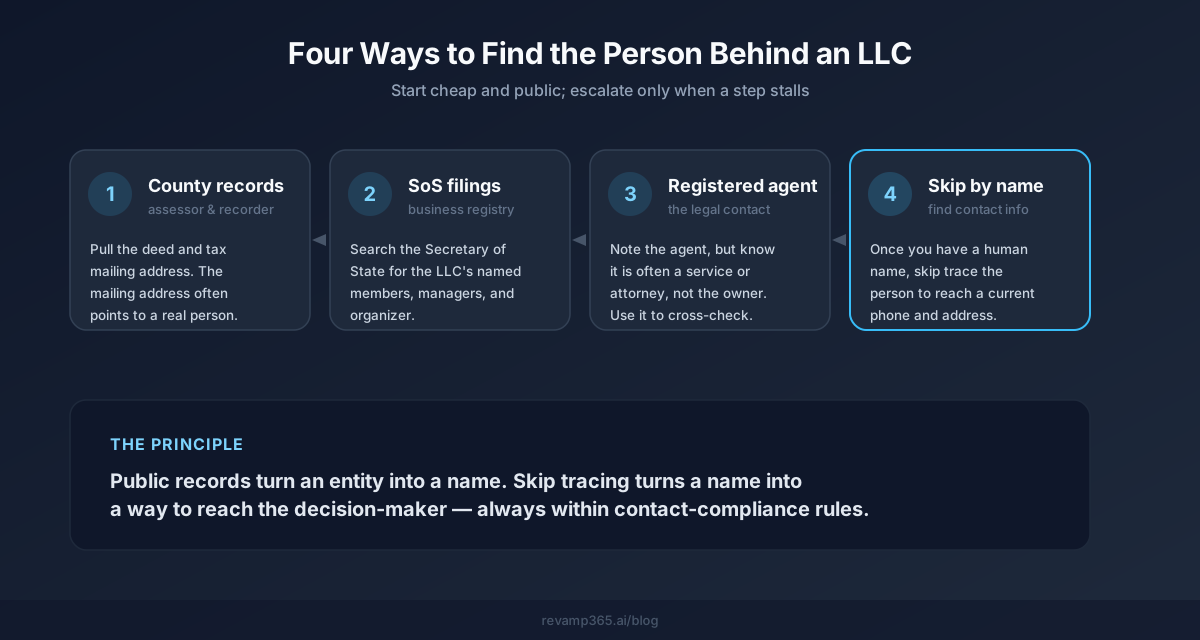
How Do You Find the Owner of an LLC Property?
Work the sources from cheapest and most public to most involved, and stop as soon as you have a confident answer. Here is the order that works:
Step 1 — Start with county property records
Begin at the county assessor and recorder for the property. Both are usually searchable online and free. Look for two things:
- The deed — it names the grantee (the LLC) and sometimes a signer or an attorney who handled the transfer.
- The tax mailing address — where the county sends the property tax bill. This is the single most useful field on the page. Owners route tax bills to an address they actually monitor, so the mailing address often belongs to the real person or their business — not the property and not a P.O. box dead end.
If the tax mailing address is a residence or a business you can tie to a name, you may have your answer in one step.
Step 2 — Look up the LLC in the Secretary of State business registry
Every LLC is registered with a Secretary of State (or equivalent business division). These registries are public and almost always free to search. Find the entity by name and open its filing. Depending on the state, you may see:
- The registered agent (covered next).
- The organizer who formed the LLC.
- Members or managers named in the formation documents or annual reports.
- The principal office address.
State disclosure varies a lot — some states list managing members by name, others only list a registered agent. If the property’s LLC was formed in a different state than where the property sits (common for holding companies), search that formation state’s registry too. The annual report is often the richest document because owners update it over time.
Step 3 — Check the registered agent — but know its limits
Every LLC must name a registered agent: the official contact for legal and government mail. It is tempting to treat the agent as the owner, but be careful — the registered agent is frequently a commercial registered-agent service or an attorney, not the person who can sell you the property. Calling them usually gets you “I can’t share client information.”
The agent is still useful as a cross-reference: if the same individual is the agent across several LLCs that own multiple properties, that person is often closely tied to the operation. Use the agent to confirm or narrow a name, not as the final answer on its own.
Step 4 — Skip trace the person, not the company
The previous steps turn an entity into a human name. Now you need a current way to reach that person — and that is what skip tracing does. Skip tracing takes a known name and address and returns current phone numbers and emails. It is built for people, which is exactly why it fails on a raw LLC and works once you have a name.
Feed the skip-trace tool the individual you identified in Steps 1–3 (the named member, manager, or organizer) along with their best-known address. This is the bridge from “I know who owns it” to “I can actually call them.” If you are doing this across a whole list, this is also where the work scales: identify the people, then skip trace them in a batch.
What If the LLC Trail Goes Cold?
Sometimes the public sources stall — the registry names only a registered-agent service, the LLC is owned by another LLC, or the tax mailing address is a virtual office. When the simple lookups dead-end, you have a few options:
- Follow the layers. If the LLC’s member is another company, look that one up too. Holding structures often resolve after one or two hops.
- Search the open web. The entity name, the principal address, or the organizer often appears in news, business directories, professional profiles, or other public filings that connect the dots.
- Check related public filings. Court records, UCC filings, and permits sometimes name the human behind the company.
- Use a research tool that does this for you. Investor platforms increasingly bundle a deeper “who is behind this entity” research step that searches public web and business records and assembles a likely owner with the supporting evidence — so you don’t have to chase every layer by hand. Revamp 365 includes this kind of entity-research capability alongside skip tracing for exactly the records that stall on a plain lookup.
The principle holds either way: keep stacking public sources until the entity resolves to a person, then verify before you act on the name.
County Records vs. Secretary of State: Which Should You Use?
Both — they answer different questions. Use this as a quick reference:
| County property records | Secretary of State registry | |
|---|---|---|
| Best question it answers | “Where does the owner get the tax bill?” | “Who is named on the company’s filings?” |
| Typical fields | Deed, tax mailing address, sale history | Registered agent, organizer, members/managers |
| Points you to | A real mailing address, often a person | A human name tied to the entity |
| Cost | Usually free online | Usually free online |
| Biggest limitation | May still show the LLC as owner | Disclosure varies by state |
In practice you cross-reference them: the registry gives you a candidate name, the county mailing address helps confirm it is the right person, and skip tracing then gives you a way to reach them.
How to Reach the Owner Once You Find Them
Finding the right person does not change the rules for contacting them. Before you call or text an owner you identified through this process, make sure you are following TCPA and Do-Not-Call requirements — they apply no matter how you sourced the number. Our TCPA compliance guide covers what investors need to know. The fastest path to a deal is reaching a real owner and doing it compliantly, so the conversation can actually go somewhere.
From there, the workflow is the same as any other lead: build your target list, resolve the owners, and run consistent, compliant outreach. LLC-owned properties just have one extra step at the front — turning the entity into a name before you skip trace.
Frequently Asked Questions
How do I find out who owns an LLC that owns a property?
Start with county property records (the deed and the tax mailing address), then look the LLC up in the state’s Secretary of State business registry to find its named members, managers, or organizer. Cross-reference the registered agent, and once you have a human name, skip trace that person to get current contact information. Combining these public sources often resolves an LLC-owned property to a real person.
Are LLC ownership records public?
Yes, LLC registration records are public. Every LLC must register with a Secretary of State, and that filing is searchable by anyone — usually for free online. How much it reveals depends on the state: some list managing members by name, others show only a registered agent and principal address. County property records, which are also public, often add the owner’s tax mailing address.
Can I find the owner of an LLC for free?
Most of the work is free. County assessor and recorder searches and Secretary of State business-entity searches are typically free to use online. The one step that usually has a cost is skip tracing the individual once you have identified them, because that pulls current phone and email data. So you can identify the person for free and pay only to get fresh contact details.
Why does the registered agent not tell me who owns the property?
A registered agent is the LLC’s official contact for legal and government mail — often a commercial service or an attorney rather than the owner. They generally will not share client information, so treat the registered agent as a cross-reference (especially when the same agent appears across multiple LLCs) rather than as the owner. The named members and managers in the filing are usually closer to the real decision-maker.
What if an LLC is owned by another LLC?
Follow the chain. Look up the parent LLC in the Secretary of State registry the same way, and repeat until you reach a named individual. Many holding structures resolve after one or two hops. If the layers are deliberately opaque, an entity-research tool that searches public web and business records can speed up connecting the entities to a person.
Is it legal to look up who owns an LLC property?
Yes. You are using publicly available records — county property data, Secretary of State filings, and open-web information — all of which anyone can access. What is regulated is how you use the information to contact someone: calls and texts must follow TCPA and Do-Not-Call rules, regardless of how you found the number.
Want the research done for you? Deep Trace explained covers how Revamp 365 investigates entity owners and returns a likely owner with a confidence rating.
Stop losing deals to “owner: LLC.” Revamp 365 helps you turn entities into reachable owners — research the person behind the company and skip trace them in one workflow.
The largest database of curated off-market deals in the nation.
Claim Your Access
Drew Farnese
Founder, Revamp 365
Veteran real estate investor with 15+ years in fix-and-flip and off-market acquisitions. Built Revamp 365 to give every investor the tools he wished existed from day one.