
What Is Batch Skip Tracing?
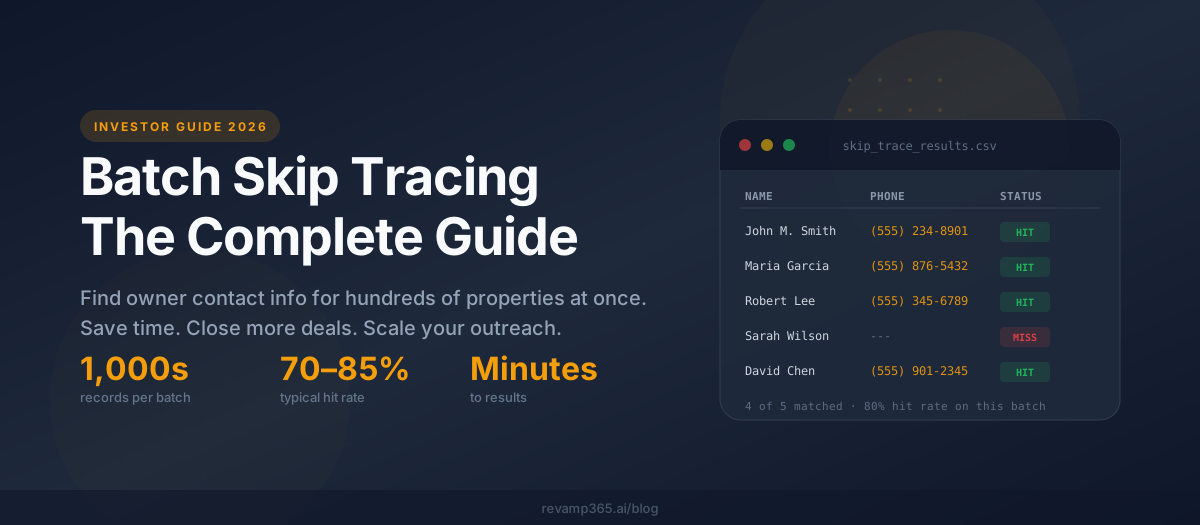
Batch skip tracing is the process of looking up contact information — phone numbers, email addresses, and mailing addresses — for a large list of property owners all at once.
Instead of manually searching for one owner at a time, you upload a spreadsheet of property addresses or owner names to a skip tracing service, and within minutes you get back verified contact details for a large share of your list.
The term "skip tracing" comes from the debt collection industry, where it originally meant tracking down people who had "skipped" town to avoid paying debts. In real estate investing, we use the same technology for a very different purpose: finding motivated sellers before your competition does.
The "batch" part is what makes it powerful. Running one skip trace at a time is slow and expensive per lookup. Running hundreds or thousands at once drops your per-record cost dramatically and delivers results in minutes instead of days.
How Does Batch Skip Tracing Work?
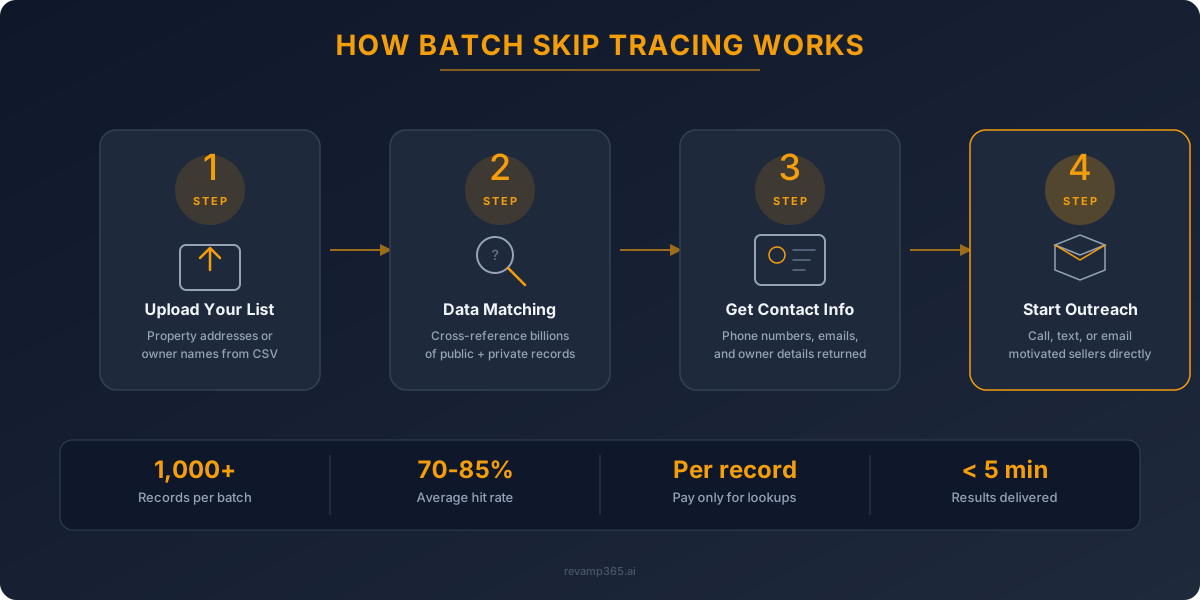
The process is straightforward, but understanding what happens behind the scenes helps you get better results.
Step 1: Build Your List
Before you can skip trace anyone, you need a list of property owners you want to contact. The most common sources are:
- Tax delinquent lists from your county assessor's office
- Absentee owner lists (owners whose mailing address differs from the property address)
- Pre-foreclosure and lis pendens filings from public court records
- Probate filings for inherited properties
- Driving for dollars lists from properties you've physically identified as distressed
- Code violation lists from your local municipality
- High-equity lists filtered from property data providers
Your list should include at minimum the property address and ideally the owner name. The more data you provide, the higher your hit rate will be. For a full walkthrough of building and filtering targeted lists by the numbers that decide a deal, see our guide on real estate list building.
Step 2: Upload and Process
You upload your list as a CSV or Excel file to your skip tracing provider. The system then cross-references your records against multiple data sources:
- Public records (county assessor data, deed filings, court records)
- Utility connection records
- Credit header data (non-financial identity information)
- Phone carrier databases (LNP/LERG data)
- Social media and online directory aggregations
- Voter registration records
- Vehicle registration databases
Modern skip tracing services search billions of records across dozens of databases simultaneously. The entire process typically takes just a few minutes for a batch of 1,000 records.
Step 3: Review Your Results
You'll get back your original list enriched with new columns:
- Phone numbers (often 2–3 per owner, ranked by likelihood of being current)
- Email addresses (personal and sometimes business)
- Current mailing address (if different from what you uploaded)
- Relative/associate contacts (some providers include these)
- Confidence scores indicating data freshness
A good provider returns a hit rate of roughly 70–85%, meaning 700–850 out of 1,000 records come back with at least one phone number. Hit rates vary by data quality and market. Records with no matches are typically vacant land owners, recently deceased individuals, or people with very limited public footprints.
Step 4: Launch Outreach
With verified contact information in hand, you can now reach property owners through multiple channels:
- Cold calling — Direct conversations have the highest conversion rate
- SMS/text messaging — Less intrusive, great for initial contact
- Ringless voicemail — Drops a voicemail without the phone ringing
- Direct mail — Use the updated mailing address for physical mailers
- Email campaigns — Low cost, good for nurturing leads over time
The best investors use a multi-touch approach: text first, follow up with a call, then drop a ringless VM to non-responders.
What Does Batch Skip Tracing Cost?
Skip tracing is usually priced per record — you pay for each property owner you look up. Across the industry, batch skip tracing commonly runs from about $0.02 to $0.15 per record depending on the provider and the depth of data returned, though some providers instead charge per successful match.
With Revamp 365, skip tracing runs $0.10–$0.20 per record depending on your plan, and it's built directly into the platform. You don't need to export your list, upload it to a separate tool, wait for results, and re-import. You select properties, click "Skip Trace," and the contact info appears on the same screen — ready for immediate outreach through the built-in dialer, SMS campaigns, or email sequences.
Why the Cheapest Skip Tracing Quietly Costs You the Most
Here's the part most "cheapest skip tracing" comparisons miss. A lot of budget and free skip tracing runs on the same commodity data vendors — the same records, resold and recycled across nearly every tool in the market. When data is cheap because it's recycled, you end up calling the exact same owners, with the same stale numbers, that every other investor in your market is already hammering. By the time you dial, that seller has heard ten versions of the same pitch this month. That isn't a lead — it's a queue.
Premium data is a different game. Fresher, more accurate, less-saturated records connect you to owners other investors can't reach — or let you reach them first. That's a blue ocean instead of a bidding war over the same picked-over list.
And the economics make the "save a penny per record" instinct backwards. A single deal can be worth tens of thousands of dollars. Paying a premium rate instead of the rock-bottom one might cost an extra $100 per 1,000 records — a rounding error against one deal. If better data connects you to even one additional deal a year, it has paid for itself many times over. Nothing else in your funnel — not your CRM, not your dialer, not your scripts — connects you to a deal better than the quality of the data underneath it.
That's a deliberate choice at Revamp 365: we price skip tracing for premium data, not recycled data. We could hand it out for free too — if we were willing to resell the same over-contacted lists everyone else does. We're not, on purpose.
Important: Cost per record isn't the only number that matters. A provider with a higher hit rate delivers more usable contacts from the same list, which lowers your effective cost per valid contact. When comparing providers, look at hit rate and data freshness alongside the headline price — and factor in the time you save when skip tracing is integrated with your CRM and outreach tools instead of living in a separate app.
Built-In vs. Standalone Skip Tracing
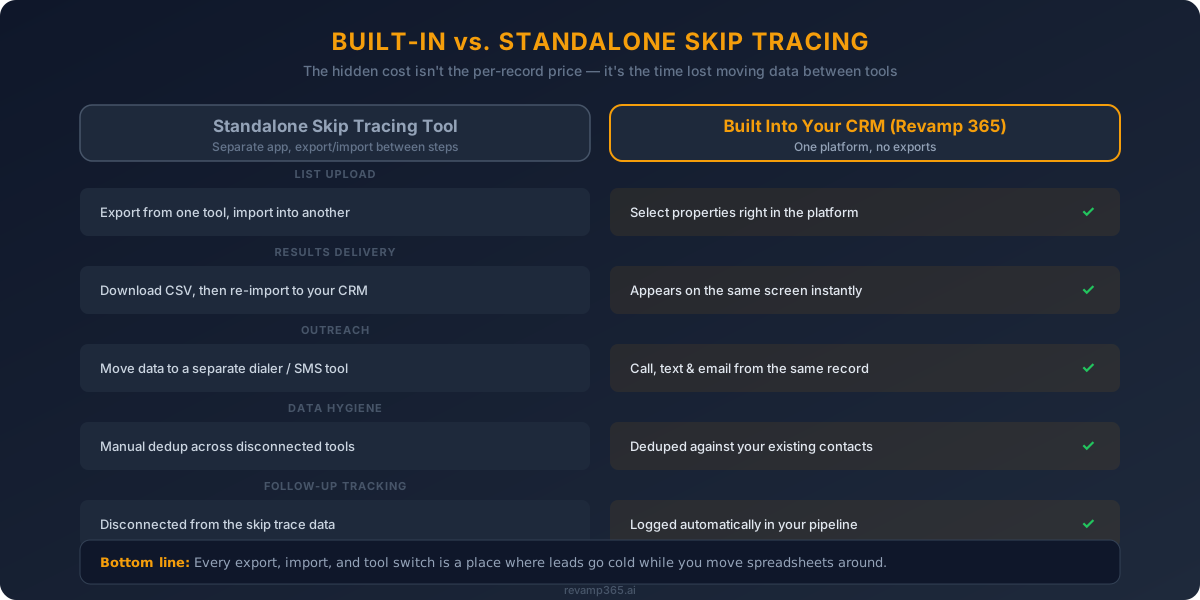
One of the biggest hidden costs in skip tracing isn't the per-record price — it's the time lost moving data between tools. Here's how an integrated workflow compares to a standalone skip tracing service:
| Standalone Skip Tracing Tool | Built Into Your CRM (Revamp 365) | |
|---|---|---|
| List upload | Export from one tool, import to another | Select properties in-platform |
| Results delivery | Download CSV, re-import to CRM | Appears on the same screen |
| Outreach | Move data to a separate dialer/SMS tool | Call, text, email from the same record |
| Data hygiene | Manual dedup across tools | Deduped against your existing contacts |
| Follow-up tracking | Disconnected from skip trace data | Logged automatically in the pipeline |
The per-record price is only part of the equation. Every export, import, and tool switch is a place where data gets lost, duplicated, or stranded — and where leads go cold while you're busy moving spreadsheets around.
The ROI of Batch Skip Tracing
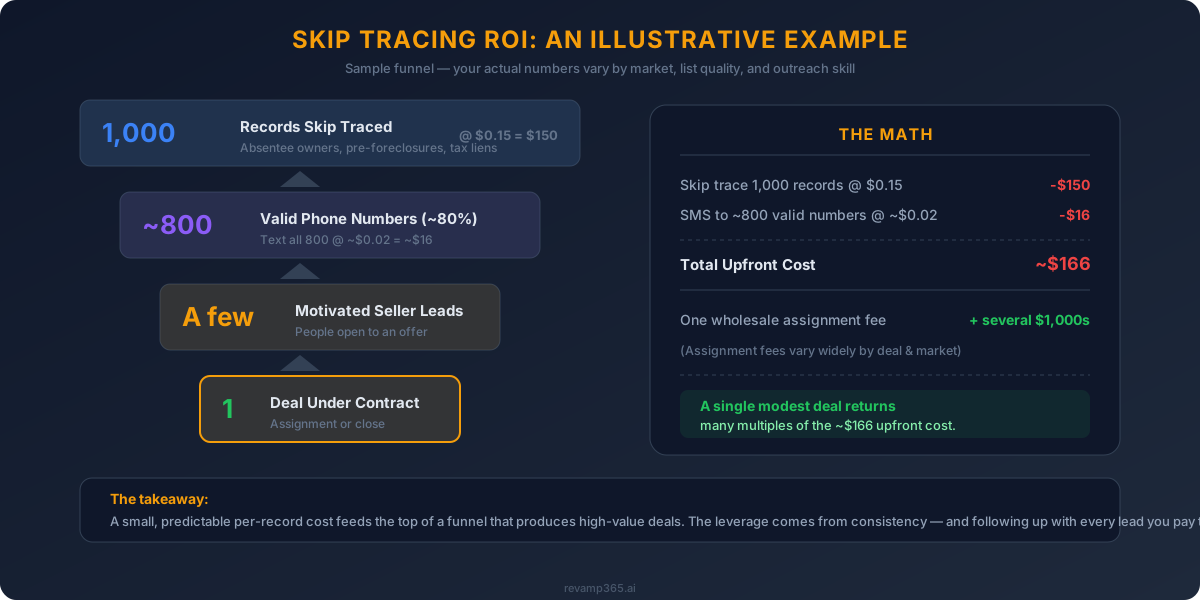
Let's walk through an illustrative example of why batch skip tracing is one of the highest-leverage activities in real estate investing. Your actual numbers will vary by market, list quality, and outreach skill — treat these as a framework, not a guarantee.
Starting point: You skip trace 1,000 absentee owners at $0.15 per record = $150.
- ~800 records come back with phone numbers (80% hit rate)
- You text all 800 (at ~$0.02/text, that's about $16). Some respond expressing interest
- A portion of those conversations turn into genuinely motivated sellers
- You make offers, and one converts to a deal
Your total cost in this example: roughly $150 skip tracing + $16 SMS = ~$166
A single wholesale assignment fee commonly runs several thousand dollars. Even one modest deal from a 1,000-record batch returns many multiples of the upfront cost.
That's the core math behind why serious wholesalers and off-market investors make batch skip tracing a non-negotiable part of their monthly routine: a relatively small, predictable cost feeds the top of a funnel that produces high-value deals. It compounds when the data is premium rather than recycled — the same outreach effort reaches owners your competition can't. The key is consistency — and following up with every lead you pay to generate.
Best Practices for Higher Hit Rates
Not all skip trace batches perform equally. Here's how to maximize your results:
1. Clean Your Data Before Uploading
Garbage in, garbage out. Before you skip trace:
- Remove duplicates — Don't pay twice for the same owner
- Standardize addresses — "123 Main St" and "123 Main Street" should be one record
- Remove corporate-owned properties — LLCs and trusts require different lookup methods
- Verify the list is current — Old lists have more deceased/moved owners
2. Include Both Name and Address
Providing both the owner's name AND the property address dramatically improves match accuracy. When the system can cross-reference both data points, it reduces false positives (wrong person) and increases true hits.
3. Stack Your Lists
The most motivated sellers appear on multiple distress indicator lists. An owner who is both tax delinquent AND in pre-foreclosure is far more likely to sell than someone on just one list.
Stack your lists before skip tracing so you can prioritize outreach to owners with multiple motivation signals.
4. Skip Trace in Batches of 500–2,000
This is the sweet spot for most investors:
- Under 500 — You're not generating enough pipeline. Unless you're in a very small market, you need more volume.
- 500–2,000 — Ideal range. Enough leads to keep your outreach consistent without overwhelming your follow-up capacity.
- Over 2,000 — Only if you have a team or automated follow-up sequences. Raw leads without follow-up are wasted money.
5. Re-Trace Every 90 Days
Phone numbers change. People move. Data gets stale. Re-tracing your core lists every quarter ensures you're working with current information. Many investors find that a re-trace picks up a meaningful share of records that were misses on the first pass.
Batch Skip Tracing vs. Individual Skip Tracing
Some investors still do individual lookups through services like TLO, IRB Search, or even manual Google searches. Here's why batch processing is almost always the better approach:
| Factor | Individual | Batch |
|---|---|---|
| Cost per record | Higher (premium per-lookup) | Lower at volume |
| Time per record | Minutes each | Seconds each |
| Scalability | 20–50/day manually | Thousands in minutes |
| Data sources | Usually 1–2 | 10+ cross-referenced |
| Best for | One-off deep dives | Systematic outreach campaigns |
The only time individual skip tracing makes sense is when you have a specific high-value property and need the deepest possible information on the owner — including relatives, associates, and historical addresses. For everything else, batch processing wins on cost, speed, and scalability.
Common Mistakes to Avoid
Mistake 1: Not Following Up
The biggest waste of money in skip tracing isn't overpaying per record — it's paying for data you never use. If you skip trace 1,000 records but only call 200 of them, you've thrown away 80% of your investment.
Build a follow-up system before you skip trace. Set up your SMS campaigns, cold calling scripts, and email sequences first.
Mistake 2: Ignoring TCPA Compliance
The Telephone Consumer Protection Act (TCPA) regulates how you can contact people by phone and text. Violations can carry steep statutory penalties per call or text. Before launching any outreach campaign, make sure you understand the rules.
Read our complete guide: TCPA Compliance for Real Estate Investors
Mistake 3: Chasing Quantity Over Quality
Skip tracing 10,000 random property owners is less effective than skip tracing 1,000 carefully selected motivated sellers. Spend more time building targeted lists and less time mass-blasting everyone in the county.
Mistake 4: Using Only One Outreach Channel
Some owners don't answer calls. Some ignore texts. Some don't check email. A multi-channel approach — combining calls, texts, voicemail drops, and direct mail — ensures you reach the maximum number of motivated sellers.
Mistake 5: Not Tracking Your Numbers
If you don't know your hit rate, response rate, and cost per deal, you can't optimize your process. Track everything from day one so you can identify what's working and double down on it.
How to Get Started with Batch Skip Tracing
Ready to start? Here's your action plan:
Build your first list. Pull 500–1,000 absentee owners or tax delinquent properties from your target market. If you don't have access to property data, Revamp 365's property search includes nationwide coverage with built-in list building.
Clean and deduplicate. Remove corporate owners, duplicates, and incomplete records. You want clean data going in.
Run the skip trace. Upload your list and wait for results. With Revamp 365, this happens inside the platform — no exporting required.
Set up your outreach. Before you make a single call, have your cold calling scripts ready and your CRM pipeline configured.
Launch a multi-touch campaign. Day 1: Text. Day 3: Call non-responders. Day 5: Ringless VM. Day 7: Email. Day 14: Repeat the cycle.
Track and optimize. Monitor your hit rate, response rate, appointments set, and deals closed. Adjust your list criteria and outreach strategy based on real data.
Frequently Asked Questions
Is skip tracing legal?
Yes. Skip tracing uses publicly available information and legally obtained data. However, how you use the contact information is regulated. Cold calling and texting are legal but subject to TCPA rules. Always comply with Do Not Call lists and obtain proper consent for automated messaging.
What's a good hit rate for batch skip tracing?
Anything above 70% is generally considered good, and strong providers often land in the upper 70s to mid 80s. Hit rates depend heavily on your input data quality. If your hit rate is consistently below 60%, you may need to improve your input data or switch providers.
How much does batch skip tracing cost?
Pricing is per record and varies across the industry — commonly about $0.02 to $0.15 per record depending on the provider and data depth, with some providers charging per successful match instead. Inside Revamp 365, skip tracing runs $0.10–$0.20 per record depending on your plan, with no separate subscription or export step.
Why does Revamp 365 charge for skip tracing instead of giving it away free?
Because the free and rock-bottom skip tracing most platforms offer runs on the same recycled, commodity data everyone else resells — the same over-contacted owners your competition is already calling. Revamp 365 uses premium data instead: fresher, more accurate, less-saturated records that connect you to deals other investors miss. When a single deal can be worth tens of thousands of dollars, the quality of the data matters far more than shaving a few cents off the per-record price. We'd rather give you data that closes deals than data that's free because it's worn out.
How often should I skip trace the same list?
Every 90 days for active campaigns. Phone numbers change frequently — a meaningful percentage of people change their number each year. Re-tracing ensures you're working with current data.
Can I skip trace LLC-owned properties?
Partially. Standard skip tracing returns the registered agent's information, which is often a lawyer's office — not the actual owner. For LLCs, you need to get past the entity to the human behind it — which is exactly what a deeper research pass is for. Our guide on how to find the real owner behind an LLC-owned property walks through how Deep Trace identifies the decision-maker that standard skip tracing can't.
What's the difference between skip tracing and a people search?
Skip tracing is specifically designed to find current, actionable contact information. People search engines (like Whitepages or Spokeo) cast a wider net but tend to return more outdated data and lack the cross-referencing that makes skip tracing accurate. For real estate outreach, purpose-built skip tracing services consistently outperform generic people search tools.
How many records should I skip trace per month?
It depends on your market and capacity. Many solo investors start with 500–1,000 per month. Teams with dedicated acquisition managers may run several thousand. The key constraint usually isn't the skip tracing — it's your ability to follow up with every lead.
Ready to skip trace your first list? Revamp 365 has skip tracing built right in — select properties, trace, and start outreach without ever leaving the platform.
The largest database of curated off-market deals in the nation.
Claim Your Access