
What is real estate investment software?
Real estate investment software is the system an investor uses to find properties, find the people who own them, and run every conversation from first contact to closing in one place. It is not a general-purpose sales CRM with a "property" custom field bolted on, and it is not a property-data subscription you export a CSV from. The category exists because the investor workflow has three things a normal sales workflow does not: the lead is a property before it is a person, the person is often hidden behind an LLC or a trust, and the follow-up runs for months.
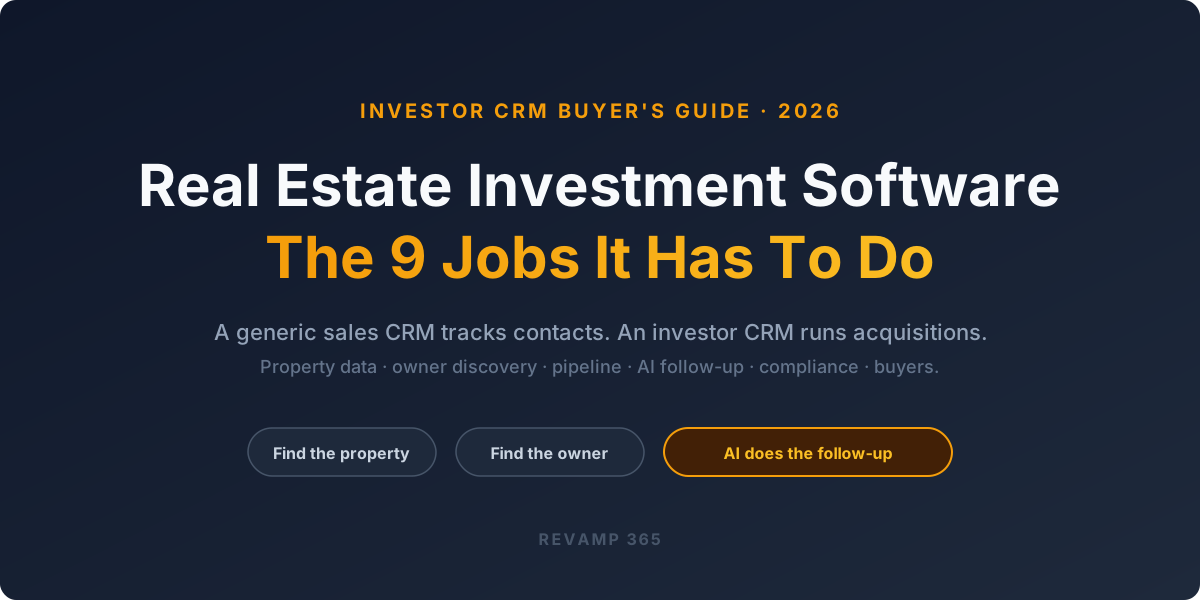
Most tools in this category solve one slice. This guide is the checklist for the whole job — the nine things real estate investment software has to do in 2026, what "good" looks like for each, and how to tell a real investor CRM from a repackaged sales CRM before you pay for a year of it.
Why do general-purpose CRMs fail real estate investors?
A general-purpose CRM fails investors because it models a company buying a product, and investing is a person selling a property. Four things break immediately:
- There is no property object. The address, the county, the ARV, the rehab number, the lien, and the owner are all one record in reality and five text fields in a generic CRM.
- The contact record starts empty. In normal sales the lead fills out a form. In investing you start with an address and no phone number, so the system has to produce the contact, not receive it.
- The pipeline stages are wrong. "Demo scheduled" and "Proposal sent" do not map to "Under contract," "Due diligence," "Marketing for assignment," or "Title and closing."
- Outreach compliance is not the CRM's problem. In investing it is: you are cold-contacting property owners, and calling-window rules, litigator lists, and do-not-contact flags have to live in the same system that sends the message.
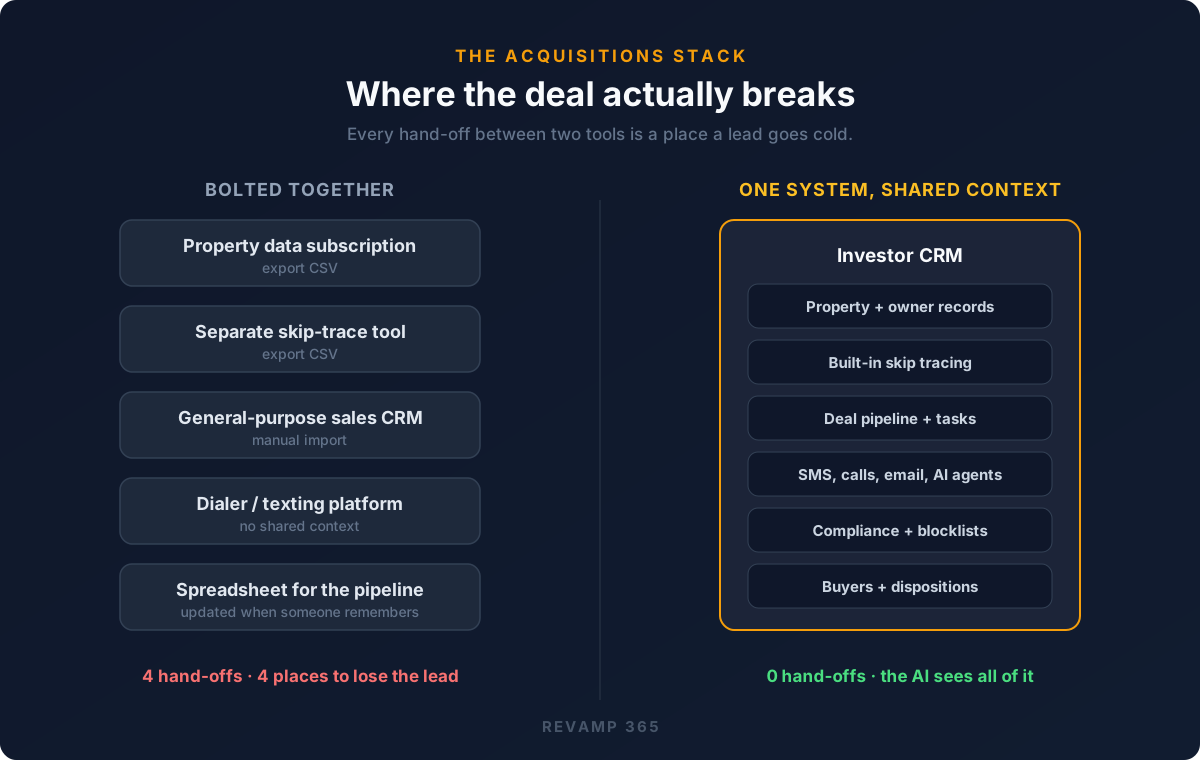
You can force a generic CRM to do this. Investors do it every day with spreadsheets and sync tools. The cost is not the subscription — it is the four hand-offs where a lead quietly stops moving.
What are the 9 jobs real estate investment software has to do?
| # | The job | What "good" looks like |
|---|---|---|
| 1 | Find the property | Nationwide records with investor filters (equity, absentee, distress, county), not just a listing feed |
| 2 | Find the owner | Skip tracing built in, plus a path through LLC- and trust-owned parcels |
| 3 | Score the lead | Scoring driven by two-way engagement and stated intent, never by how much you blasted |
| 4 | Run a real pipeline | Stages that match wholesale, fix-and-flip, and buy-and-hold — with the deal fields each one needs |
| 5 | Do the follow-up | The system executes the cadence itself across SMS, calls, and email — you approve, you don't type |
| 6 | Stay compliant | Calling windows, DNC and litigator scrubs, and per-number blocklists enforced before send |
| 7 | Underwrite in place | Comps, ARV, rehab, and fee math attached to the deal record, not in a separate spreadsheet |
| 8 | Move the deal | A buyer list, buy-box matching, and a disposition path that doesn't start with a fresh export |
| 9 | Keep one record per human | Deduplication, clean imports, and a single timeline per person across every channel |
Everything below is how each job actually gets done, with the specifics from a platform that ships all nine — Revamp 365's investor CRM.
1. Find the property before it is a listing
The first job is sourcing. A listing feed is not sourcing — by the time a property is listed, the seller has an agent and a price. Investor-grade sourcing means nationwide property and owner records you can filter on the signals that predict a motivated seller: equity position, absentee ownership, length of ownership, tax and lien status, and distress events, narrowed to the counties you actually buy in.
The practical test: can you build a list from filters inside the system and have that list become CRM contacts without an export? If the answer is "download the CSV and import it," you have a data vendor, not investment software. See how to build a filtered off-market list and nationwide property data.
2. Find the owner — including the ones hiding behind an LLC
Sourcing gives you an address. Deals need a phone number. Skip tracing is the step in between, and whether it lives inside your software or outside it is the single biggest workflow difference in this category.
Built-in skip tracing at Revamp 365 runs $0.10–$0.20 per record depending on plan, billed per record rather than as a separate subscription — so tracing a list is a button on the list, not an export to a second vendor and an import back. See Revamp 365 skip tracing and how to trace a list in bulk.
The harder version of this job is the one most tools skip entirely: LLC- and trust-owned properties. The tax record says "123 Main Holdings LLC" and a registered-agent address, which is a mailbox, not a decision-maker. Piercing that requires walking Secretary of State filings, officer and principal records, and address history to reach the human who can actually sign. That is owner discovery, not skip tracing — and if your software can't do it, your best-equity, least-competed leads are the exact ones you never contact.
3. Score leads on intent, not on how loud you were
Most "lead scoring" is activity scoring: it goes up when you send more. That is backwards — it ranks your effort, not the seller's interest.
Revamp 365's lead score is a 0–100 signal score built from what actually predicts a deal: AI deal memory extracted from call transcripts and SMS threads (stated deal stage, motivation, timeline, price talk), the latest analyzed call's interest level and sentiment, and two-way engagement — inbound replies and connected calls, never outbound blast volume. Data completeness barely moves it, which is the point: a freshly skip-traced list stays cold until a human actually engages with you.
The buying test for any platform: ask what makes a score go up. If the answer includes "emails sent" or "calls attempted," the score is a vanity metric and your acquisitions team will learn to ignore it.
4. Run a pipeline built for the strategy you actually run
Wholesaling, fix-and-flip, and buy-and-hold are three different businesses with three different critical paths, and a single generic pipeline serves none of them.
Revamp 365 seeds a separate stage set per deal type: wholesale (Under Contract to Due Diligence to Marketing for Assignment to Buyer Identified to Assignment Executed to Title & Closing to Closed), fix-and-flip (which adds Renovation, Listed for Sale, and Sale Closing), buy-and-hold (which adds Financing and Tenant Placement), plus a general set. Each stage carries its own task templates — "Order title search," "Collect buyer proof of funds," "Confirm clear-to-close from title" — so moving a deal forward creates the checklist instead of relying on memory.
The deal record itself carries the fields the strategy needs: contract price, ARV, rehab estimate, assignment fee, projected profit, holding and selling costs, earnest money amount and due date, inspection and financing deadlines, closing date, and the title company, lender, and buyer contacts. Those are structured deal fields, not notes — which is what makes them filterable, reportable, and automatable.
5. Let the software do the follow-up, not just remind you to do it
This is the job where AI-native and AI-flavored software separate.
A reminder system tells you to follow up. An AI-native system runs the follow-up: it holds the conversation over SMS, makes and answers calls, books the appointment, and hands you a lead that is already qualified. The difference is not a feature toggle — it is whether the AI can see the whole record (the property, the owner research, the call transcripts, the pipeline stage, the tasks) or only the one channel it was bolted onto.
In Revamp 365 the automation engine registers 74 trigger definitions across 11 categories — contact, deal, call, SMS, email, booking, task and note, schedule and time, AI agent, cross-automation, and webhook — and the actions those triggers fire include sending SMS and email, updating contact and deal fields, moving deal stages, creating tasks and notes, branching, delays, webhooks, running an AI prompt, enrolling or pausing an AI agent, and starting a voice campaign call. SMS runs $0.02–$0.04 per message depending on plan; AI voice agents handle the calls.
That is the compounding argument, stated plainly: because the AI sits on top of the whole system rather than beside one channel, it gets more capable as the models do. Platforms that bought a third-party AI bolt-on get slower and more expensive to integrate with every generation. Read how to automate the acquisitions side of the business.
6. Enforce compliance before the message goes out
Cold outreach to property owners is a regulated activity, and the enforcement point has to be the system that sends — not a policy in a doc.
Real estate investment software should hold, at minimum: a per-account blocklist with distinct do-not-call, do-not-text, and spam types checked before every dial and send; a calling window enforced in the lead's local time zone (Revamp 365 defaults to an 8:00 a.m. to 9:00 p.m. window, derived from the number's own time zone rather than yours); and a scrub path against federal and state DNC and TCPA-litigator lists before a campaign runs.
The evaluation question is simply: what does this platform check before it dials? If the answer is "nothing, that's on you," the compliance risk of the tool is a real line item. Start with what TCPA compliance requires of investors.
7. Underwrite in the same record as the conversation
If your numbers live in a spreadsheet, your acquisitions manager is negotiating from a stale copy. Underwriting belongs on the deal.
Good investment software attaches valuation to the property record: comparable sales, an ARV estimate, rehab budget, and the fee or profit math for the strategy — recalculated as the deal moves rather than at the moment someone remembered to update the tab. See instant comps and how to run comps like a pro.
8. Move the deal — buyers are part of the software, not a separate list
Acquisitions gets the contract. Dispositions gets paid. Most investor software stops at acquisitions, which is why so many wholesalers keep their buyer list in a phone's contacts app.
The requirement is a buyer record with a real buy box — strategy, counties, property types, price range, ARV range, beds and baths, cash-flow and flip-profit thresholds — so a new contract can be matched against buyers automatically instead of blasted to everyone. Then a deal marketplace to move it, and a matching contact record on the buyer so the disposition conversation lives on the same timeline as everything else. More on building the buyer side.
9. Keep exactly one record per human
The least glamorous job, and the one that quietly destroys pipelines. Buy three lists, import a partner's spreadsheet, and pull a county file, and the same seller now exists four times. Four records means four separate follow-up cadences, four partial timelines, and eventually four texts from your business to a person who already told one of them to stop.
What to require: duplicate detection that clusters on phone, email, name, and mailing address; a merge that preserves the whole timeline rather than keeping one record and deleting the rest; and guardrails that refuse to auto-merge the ambiguous cases — a shared household phone line under two surnames, or two distinct CRM IDs on one contact point — and route them to a human instead. Import hygiene is the same job upstream: normalize phone numbers on the way in, or the deduplication never fires.
What does "AI-native" actually mean in real estate investment software?
AI-native means the AI does the work, not that the product has AI features. The distinction is testable, and it comes down to context:
| Bolted-on AI | AI-native | |
|---|---|---|
| Where the AI lives | Beside one channel (a chatbot, a note summarizer) | On top of the whole record — property, owner, transcripts, pipeline, tasks |
| What it does | Drafts something for you to send | Runs the conversation, books the appointment, updates the record |
| What it knows | The current thread | Everything the CRM knows about that deal |
| What happens as models improve | Another integration to buy, wire, and pay for | The whole system gets more capable at once |
An investor CRM that is AI-native can summarize a contact automatically when a call connects or an inbound text arrives, keep a "next steps" field current off the same signals, extract deal memory from transcripts and feed it into the lead score, and run a multi-day SMS cadence that reads replies and adapts. Those are the same capabilities described in jobs 3 and 5 — which is the point. In an AI-native system they are not separate features; they are the same context used four different ways.
How should you evaluate real estate investment software?
Run this checklist against any platform before you commit to an annual plan:
- Can I build a list and contact it without a single CSV? Export/import steps are where speed-to-lead dies.
- Is skip tracing inside, and priced per record? Per-record beats a subscription tier you may not use.
- Can it find the human behind an LLC? Ask specifically. Most cannot.
- What makes a lead score go up? If outbound volume raises it, the score is noise.
- Do the pipeline stages match my strategy? Wholesale, flip, and rental are not one pipeline.
- Does the AI send, or only suggest? That is the whole difference in cost per deal.
- What does it check before it dials or texts? Blocklists, calling windows, DNC scrubs.
- Where do buyers live? If the answer is "a separate list," dispositions will stay manual.
- How does it handle duplicates? Ask what happens to the timeline on a merge.
- What does it cost per unit of work — not per seat? Records traced, messages sent, calls made.
Frequently asked questions
What is the difference between real estate investment software and a real estate CRM?
A real estate CRM manages relationships; real estate investment software manages acquisitions. The investment platform starts upstream — with property records and owner discovery — and only then becomes a CRM. A CRM built for agents starts with a client who already exists. For investors, the contact usually does not exist until the software creates it. Here is how the investor pipeline is structured.
Do I need separate software for wholesaling, flipping, and rentals?
No, but you do need separate pipelines. The three strategies share sourcing, skip tracing, and outreach, then diverge completely after "under contract." Any platform worth buying seeds a distinct stage set and task list per deal type rather than forcing one generic pipeline on all three.
How much does skip tracing cost inside an investor CRM?
Inside Revamp 365 it is $0.10–$0.20 per record depending on plan, billed per record. The thing to compare across platforms is not only the headline rate but whether tracing requires leaving the system — an export-and-reimport loop costs more in lost speed than the per-record difference.
Can real estate investment software find the owner of an LLC-owned property?
Some can; most cannot. Standard skip tracing matches a person to contact data, so it returns nothing useful when the owner of record is an entity. Reaching the human requires Secretary of State entity filings, officer and principal records, and address correlation. If you buy off-market, this is worth testing before you pay — here is the full method.
Is an all-in-one platform better than best-of-breed tools?
For investors, the hand-offs are the cost. Best-of-breed wins when each tool is used independently; acquisitions is the opposite — one continuous motion from list to contract. Every export, import, and sync is a place a lead stalls, and it is also a place the AI loses context. That context is exactly what makes an AI-native system work at all.
What should I look at first if I am switching platforms?
Your dead leads. Import them, run owner discovery on the LLC-owned ones, and put the rest into an AI follow-up cadence. If a platform can resurrect deals you already paid to generate, the rest of the evaluation gets a lot easier. Then read how to scale from one deal to ten.
The short version
Real estate investment software has to do nine things: find the property, find the owner, score the lead honestly, run a strategy-shaped pipeline, execute the follow-up itself, enforce compliance before it sends, underwrite in place, move the deal to a buyer, and keep one record per human. Tools that do three of the nine are not cheaper — they are the four hand-offs where your leads go cold, priced separately.
See what an AI-native investor CRM looks like end to end — property data, owner discovery, pipeline, and AI follow-up in one system. Start free with $5 in credit.
The largest database of curated off-market deals in the nation.
Claim Your Access