
If you are searching for Objection Proof AI reviews, you are almost certainly at a specific moment in your business. You are doing real volume. You have leads sitting in a CRM that nobody is working. You have heard that AI can call them. And you are trying to figure out whether a five-figure commitment to an AI sales vendor is a smart move or an expensive lesson.
This review is written for that moment. The first half is a straight assessment of Objection Proof AI — what it is, what it costs, what its own customers say, and what its public critics say. The second half is the part almost nobody covers, and it is the part that determines whether any AI sales tool works for you: the difference between bolting an AI layer onto a broken acquisition process and rebuilding the process itself.
We build competing technology. You should read this knowing that. So everything factual below is either sourced to Objection Proof AI's own published material, sourced to a public review you can go read yourself, or sourced to our own published pricing. Where we make a case for our approach, we label it as a case, not a fact.
In this review
- What Objection Proof AI actually does, feature by feature
- Real published pricing — install fees and monthly
- What operators say publicly, good and bad
- A 7-question scorecard for evaluating any AI sales vendor
- The layer-vs-infrastructure problem that sinks most AI deployments
- How to test AI voice on your own leads before paying anyone
What Is Objection Proof AI?
Objection Proof AI is an AI sales system for real estate acquisition teams, built by Steve Trang — a name most operators in this industry already know from Real Estate Disruptors and from years of sales training inside wholesaling shops.
That pedigree matters, and it is the single strongest thing about the product. This is not a generic AI voice startup that discovered real estate last quarter. The system is built on a sales methodology that was taught to acquisition reps long before it was taught to a language model. When the company says its system is trained on a sales process refined across a very large volume of closed deals, that claim is at least structurally believable in a way most AI vendor claims are not.
According to Objection Proof AI's own site, the product is aimed at wholesalers, house flippers, and land investors doing at least three deals a month. Take that qualification seriously — it is not marketing filler. It tells you the system assumes existing lead flow, an existing CRM, and existing humans to hand appointments to. If you are still figuring out which list to pull, this product is not built for you, and no amount of AI will fix that.
The named components
Objection Proof AI publishes six components:
| Component | What it is |
|---|---|
| AI Follow-Up Caller | Outbound AI voice that works your existing lead database |
| AI Lead Manager | Intake, qualification and routing of new leads |
| AI Sales Manager | Oversight and analysis layer across rep activity |
| AI Roleplay Bots | Practice partners for your human closers |
| Rep Scorecards | Performance measurement for human reps |
| Weekly Live Training | Live coaching sessions |
Look carefully at that list, because it reveals the actual product philosophy. Three of the six components — Roleplay Bots, Rep Scorecards, and Weekly Live Training — are aimed at making your humans better. This is fundamentally a sales-training company that has added AI execution, not an infrastructure company that has added training.
That is a legitimate and defensible model. If your bottleneck is that your acquisition reps are mediocre on the phone, a vendor whose core competency is coaching reps is a rational purchase. Just be clear-eyed that you are buying a sales enablement product with an AI calling layer attached, and price your expectations accordingly.
What it connects to
Objection Proof AI lists integrations with GoHighLevel, REI Reply, Salesforce, HubSpot, Podio, and most major real estate CRMs, with go-live stated at 24 to 72 hours from signing.
This is the defining architectural fact about the product, and we will come back to it repeatedly: Objection Proof AI is a layer that sits on top of a CRM you already own. It does not replace your CRM. It does not supply your data. It does not own your telephony relationship. It plugs into a stack you assembled from other vendors and adds intelligence to one slice of it.
Whether that is a strength or a weakness depends entirely on how good the stack underneath it already is. Which is the whole argument of the second half of this review.
What Does Objection Proof AI Cost?
Objection Proof AI publishes its pricing, which is more transparency than a lot of this category offers. As listed on their site:
| Package | Install fee | Recurring |
|---|---|---|
| Complete Access | $5,000 | $1,500/month |
| Complete Access (annual) | — | $15,000/year |
| Lead Manager Only | $3,000 | $997/month |
A few observations an operator should make before signing anything.
Year one on Complete Access is a serious commitment. Install plus twelve months of the monthly rate puts you meaningfully into five figures before you have closed a single AI-sourced deal. On the annual plan you are committing to $15,000 up front plus the install fee. That is not a criticism — implementation genuinely costs money, and vendors who pretend otherwise usually make it back somewhere less visible. But it does set the bar for what the system has to produce.
Do the deal math before the demo, not after. If your average assignment fee is $12,000, Complete Access needs to produce roughly two incremental deals in year one just to break even against the software. That is a reasonable bar for a system working a large dormant database. It is a much harder bar if you have 900 leads total.
Ask specifically what the install fee buys and whether it is refundable. This is the single most important question in the entire purchase, and we say that because of what shows up in the public reviews.
Before you pay a $5,000 install fee, hear an AI agent call you.
Create a free Revamp 365 account, build a voice agent, and run a live test call in your browser. No subscription. Phone-verified accounts get $5 in starter credit to run it on us.
Test AI Voice FreeWhat Do Objection Proof AI Reviews Actually Say?
Here is where an honest review has to hold two things at once.
The published wins
Objection Proof AI's site features named operators with specific outcomes. Among the claims published there: contact rate up over 4x and cost per contract down to $450 (Nick Perry); $200K+ in revenue from new lead intake and a $50K deal booked by the AI on a Sunday (Anthony Slane); a $60K deal recovered from a two-year-old lead and monthly deals up from 6 to 8 (Jacob Matlock); 17 contracts in a record month against 1,200 AI calls per day (Stratton Brown); lead conversion up 16% (Stephanie Betters). The company also states its system turns 64% of quality conversations into appointments, and that out of every 1,000 calls the AI makes, only 2 prospects ask whether it is AI.
Treat these exactly as what they are: vendor-published testimonials from named operators. They are not independently audited, the sample is self-selected, and every AI vendor in this space publishes a version of them. That does not make them false — the operators are real and several are well known. It means they establish an upper bound on what is possible with the product, not an expectation of what is typical.
The $60K-from-a-two-year-old-lead story is the one worth internalizing, because it is directionally the most important claim in the category. Dormant database reactivation is where AI calling genuinely shines, and we will make the same argument later in this review about our own system.
The public criticism
In April 2026, a BiggerPockets forum thread titled "Steve Trang - Objection Proof AI" was started by an operator who describes himself as a paying customer. His account, in his words, includes: the system was slow and clunky and prospects could tell it was AI, warm transfers "didn't work at all," support tickets were marked resolved without a solution, the $5,000 installation fee was non-refundable regardless of performance, and his contract was terminated roughly two weeks into a year-long agreement. He also states that direct outreach to Steve Trang went unanswered.
We are linking that thread rather than paraphrasing it into something harsher, and you should read it yourself and weigh it. It is one customer's public account. It is not a pattern by itself, and forum threads skew negative by nature — satisfied customers rarely start them.
But two specifics in it are worth carrying into your own diligence regardless of which vendor you choose:
Warm transfer is the highest-risk feature in any AI calling system. It is the moment a live, interested seller has to be handed from a machine to a human in real time, and it depends on telephony, routing, availability logic, and CRM state all working simultaneously. It is also the feature most likely to be demoed on a happy path and fail in production. Never buy an AI calling product without watching a warm transfer happen live, unscripted, to a phone you control.
A non-refundable install fee transfers all implementation risk to you. That is a normal structure in this industry, and it is not inherently predatory. But it means the vendor gets paid whether or not the deployment works, which is exactly why you want proof of value before the fee, not after it.
How to read the two together
The reasonable synthesis is this: Objection Proof AI is a real product with real customers getting real results, sold by someone with genuine credibility in this industry, and it has at least one detailed public account of a deployment going badly. That describes most enterprise-ish software. Your job is not to decide whether the vendor is good or bad in the abstract. Your job is to structure the purchase so that a bad outcome costs you a demo instead of $20,000.
The 7-Question Scorecard for Any AI Sales Vendor
Use this on Objection Proof AI. Use it on us. Use it on the next three vendors that DM you on Instagram. Any vendor that cannot answer all seven in a single call is asking you to buy on faith.
Ask before you sign
- Can I hear it, live, on my phone, right now? Not a recording. Not a curated demo call. A live call to a number you name, on a script you did not pre-approve.
- Show me a warm transfer fail and tell me what happens next. Does the lead get a callback task? A text? Does it vanish? The failure path tells you more than the happy path.
- Who owns the phone numbers and the carrier registration? If your numbers get flagged as spam, whose problem is it and who fixes it?
- What exactly does the install fee buy, and what is the refund condition? Get it in writing. "Non-refundable" is an acceptable answer — an unclear answer is not.
- What happens to the conversation data if I cancel? Transcripts, recordings, dispositions, and the CRM state the AI created. Do you keep it?
- What does this cost me at 10x my current volume? Per-minute, per-message, per-record. Vendors who only quote a monthly subscription are hiding the number that will actually determine your cost.
- What has to already be true on my side for this to work? An honest vendor will name your prerequisites. A vendor who says "nothing, we handle everything" is setting up the conversation where the failure becomes your fault.
Question 7 is the one that leads into the real subject of this review.
The Question Most Operators Ask Too Late
Every operator evaluating AI sales tools asks some version of: which AI is best?
That is the wrong first question, and asking it in the wrong order is why a large share of AI deployments in this industry underperform regardless of vendor.
Here is the actual sequence that produces a closed deal:
Buy Box → Data → Targeting → Outreach → Conversation → Qualification → Follow-Up → Opportunity → Acquisition Team
An AI calling product — any of them, ours included — operates on exactly three of those nine stages: Outreach, Conversation, and Qualification. It is extremely good at those three. It is structurally incapable of fixing the other six.
So when you bolt a best-in-class AI caller onto a stack where the data is stale, the targeting is a list you bought fourteen months ago, the follow-up dies when a rep quits, and the CRM is a graveyard nobody trusts — the AI faithfully executes high-quality conversations against the wrong people at the wrong moment, and then hands the outcome back into the same broken pipe it came from.
You will get some deals. Dormant databases are genuinely full of money, and even a mediocre reactivation campaign finds some of it. But you will not get the transformation you were sold, and you will conclude that AI does not work, when what actually happened is that you upgraded one link in a nine-link chain.
Layer versus infrastructure
Look at how most acquisition companies are actually assembled:
| Function | Typical operator's stack |
|---|---|
| Property data | Vendor A |
| Skip tracing | Vendor B |
| CRM | Vendor C |
| Dialer / telephony | Vendor D |
| SMS | Vendor E |
| Vendor F | |
| AI voice | Vendor G |
| Analytics | Spreadsheets |
| Integration between all of it | A VA, a Zap, and hope |
Seven or more vendors, none of which were designed to know about each other, held together by employees whose real job is data entry. Every handoff between two of those boxes is a place where a lead goes cold, a disposition never syncs, a phone number is dialed by two systems on the same afternoon, or a hot conversation dies because the CRM never learned it happened.
Adding an eighth vendor to that diagram — even an excellent one — does not fix the diagram. It adds one more integration boundary to the six you already have.
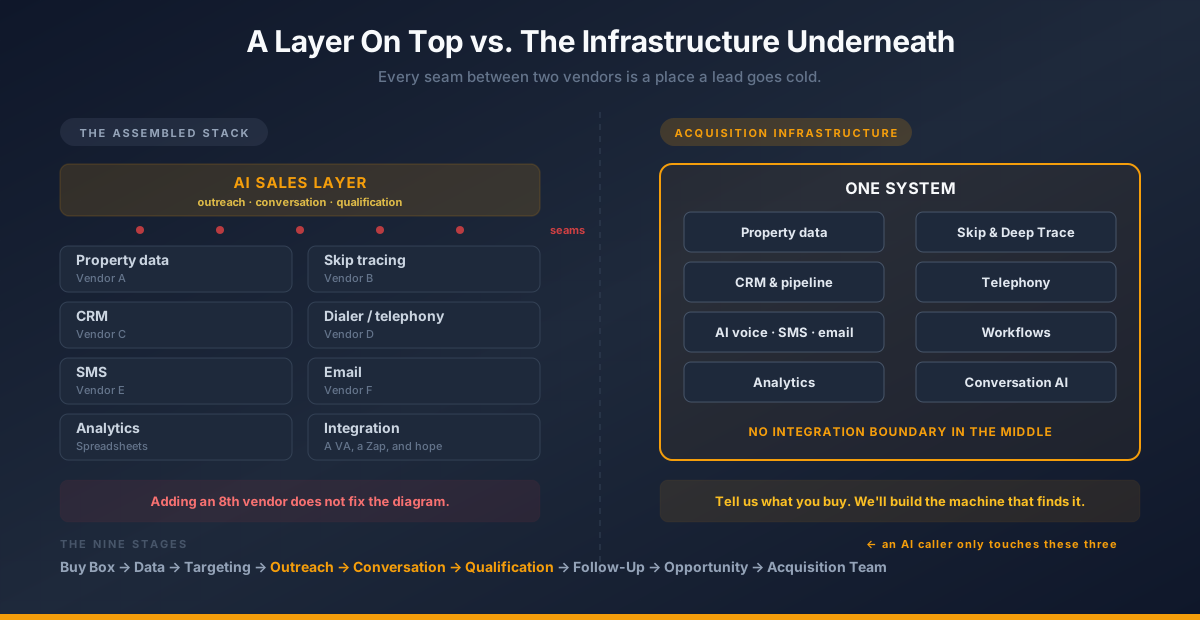
This is not a criticism unique to Objection Proof AI. It is the structural condition of the entire category. A sales-training company cannot supply your property data. A data company cannot run your conversations. A CRM company does not own telephony. Every point solution in this market is, by definition, solving one link.
What We Think You Should Be Buying Instead
Here is our actual position, stated plainly as an argument rather than dressed up as a fact.
We think the correct unit of purchase is not an AI feature. It is acquisition infrastructure: the entire machine between "here is what I buy" and "here is a seller ready to talk to my closer," owned by one system that can see every stage at once.
The promise we build around is one sentence:
Tell us what you buy. We'll build the machine that hunts it down and hands it over.
That means you define the buy box. You keep your acquisition strategy, your markets, your offer discipline, your negotiating. Those are yours and they should be — you are better at them than any software company. What you hand over is the infrastructure between that definition and the opportunity landing in front of your team.
Concretely, that machine has two engines.
Engine One: Continuous Opportunity Generation
You describe what a good deal looks like — property characteristics, ownership profile, equity position, valuation band, distress signals, listing status, market activity, the patterns in the deals you have already closed. That definition becomes a live query against property data rather than a one-time list pull.
The difference between a list and a buy box is timing. A list is a photograph of who matched your criteria on the day you exported it. A buy box is a standing order — properties enter your pipeline on the day they start matching, which is usually the day something changed in the owner's life. That change is the whole reason the deal exists.
From there you choose which channels work the opportunity: AI voice, SMS, email, human dialing, or your acquisition reps directly. The targeting and the outreach are the same system, so a property that just entered your buy box can be called that afternoon without an export, an upload, a mapping step, or a VA.
We want to be precise about the promise here, because this is where our category lies to people. We are not claiming to magically generate deals. We are claiming to continuously identify and work the opportunities that match the criteria you give us. If your buy box is wrong, we will very efficiently find you properties you do not want. The strategy stays your job.
Inside Revamp 365 the supporting pieces are already there rather than integrated in: property and owner data, skip tracing built into the platform at $0.10–$0.20 per record depending on plan, and Deep Trace for the harder identity problems — LLC-owned properties where standard skip tracing returns a registered agent instead of a human — at $0.25–$1.00 per record depending on plan.
Engine Two: The Database You Already Paid For
This is the one we would lead with if we could only make one argument.
Established acquisition companies are sitting on an enormous, almost entirely unworked asset: their own dead leads. Thousands, sometimes tens or hundreds of thousands of them. Every one of those records cost real marketing dollars.
Go read the reasons they died:
- Somebody called six months ago and nobody answered.
- The seller said "call me back in the spring." Spring came and went.
- They wanted too much money. Twelve months of carrying costs later, maybe they do not.
- An appointment was set and never happened.
- The acquisition rep who owned the relationship quit.
- A CRM task came due, nobody did it, and it aged off the dashboard.
- Follow-up was supposed to be a sequence and was actually a person's memory.
None of those are "this seller will never sell." They are all "a human being ran out of capacity at a specific moment." That is precisely the failure mode a machine does not have.
So the strongest promise underneath the headline is this:
Before you spend more money generating leads, make sure you're monetizing the ones you already paid for.
That is what Engine Two does. Import or migrate your existing leads, or connect the CRM you already run. Map your pipeline stages so the AI understands what each status actually means in your business. Point AI agents at a selected segment — not the whole database, a segment, because segmentation is what separates reactivation from spam. Re-engage, qualify, follow up indefinitely, analyze the conversations, surface the ones with real motivation, and route those to a human at the moment a human is worth spending.
Notice that this is the same use case as the $60K-from-a-two-year-old-lead story on Objection Proof AI's site. We are not claiming to have discovered it. We are claiming that reactivation works better when the system doing the calling is also the system holding the lead record, the phone number, the conversation history, and the disposition — because nothing has to survive a sync.
How many leads are sitting in your CRM right now?
Whatever the number is, some percentage of them are still sellers. Build an AI agent free, point it at a sample of your dead leads, and listen to what comes back.
Build A Free AgentDon't Replace Your Acquisition Team. Give Them An Unfair Advantage.
The loudest version of the AI pitch in this industry is "fire your acquisition team, the AI does everything." We think that is both wrong and a bad business decision, and we want to be on record about it.
Humans are disproportionately valuable at a small number of things: negotiating, building rapport with a distressed seller, untangling a complicated title or family situation, and closing. Those are also the highest-leverage minutes in your entire operation, and they are exactly the minutes your reps currently do not have because they are dialing, logging, remembering, and re-reading notes.
Split the work by what each side is actually good at:
| The machine should do | The human should do |
|---|---|
| Finding and prioritizing opportunities | Negotiating |
| Dialing and initial contact | Building rapport |
| Qualification and disqualification | Solving complicated seller problems |
| Following up indefinitely, never forgetting | Reading the room |
| Logging, updating, dispositioning | Closing |
| Analyzing conversations at volume | Deciding what a deal is worth |
| Routing the right lead to the right rep | Walking the property |
That is a more believable AI story than replacement, and in our experience it is also a better product. A rep who takes six qualified, pre-warmed conversations a day closes more than a rep who dials 200 numbers to find them.
It also changes what "scaling" means. The traditional path from 3 deals a month to 10 is hiring — more reps, more management, more turnover, more training. We covered the conventional version of that in our guide on scaling a wholesaling business from 1 to 10 deals a month. The infrastructure path is to hold headcount flat and multiply what each existing rep can reach.
What Acquisition Infrastructure Actually Costs
We publish our pricing, so here is the honest comparison rather than a vague "contact us."
| Free | Pro+ | Dealmaker Syndicate | |
|---|---|---|---|
| Monthly | $0 | $197/month | $1,000/month + implementation |
| Model | Pay-as-you-go credits, no subscription | Self-serve, you build and run it | Built and deployed around your operation |
| Skip trace | $0.15/record | $0.10/record | $0.10/record |
| Deep Trace | $1.00/record | $0.50/record | $0.25/record |
| SMS | — | $0.04/text | $0.02/text |
| — | $0.004/email | $0.002/email | |
| AI voice markup | — | $0.35/call | $0.05/call |
| AI voice display rate | — | $0.50/min | $0.12/min |
Three things to notice.
The free tier is a real product, not a trial. There is no subscription. You pay per unit for what you actually use, and phone-verified accounts get $5 in starter credit. You can build an AI voice agent and run a live test call on a free account — that is not a gated feature. We will come back to this in the next section because it is the single most useful thing in this entire article.
The self-serve tier is $197/month, and we do not hide it. If your team wants access to the technology and wants to build and operate the system yourselves, that is exactly what Pro+ is for, and for a lot of operators it is the correct purchase. Nobody at our company will try to talk you out of it. An offer is only credible when the cheaper option is genuinely available.
The infrastructure tier trades commitment for unit economics. Dealmaker Syndicate is $1,000/month plus an implementation fee, and the usage rates drop across the board: SMS and email are half of Pro+, Deep Trace is half, and the AI voice per-call markup goes from $0.35 to $0.05. At sufficient volume the higher-commitment plan is cheaper in total spend, not more expensive — which is the only version of a premium tier we think is defensible. It also includes external CRM connections, the lead-gen website builder, white-glove training, premium support, and a deal guarantee.
How it compares on structure
We are not going to publish a head-to-head claiming we are cheaper than Objection Proof AI, because that comparison depends entirely on your volume and it would be dishonest to imply otherwise. What we will point out is the structural difference:
- Objection Proof AI is a layer priced at $5,000 install plus $1,500/month that improves the stack you already assembled — and you keep paying every vendor underneath it.
- Dealmaker Syndicate is the stack itself at $1,000/month plus implementation, with the data, CRM, telephony, SMS, email, AI voice, and analytics under one roof.
Which is the better buy genuinely depends on whether the stack underneath you is worth keeping. If you love your CRM, your data source is excellent, and your only gap is conversation quality, a layer is the right answer and you should buy one. If the honest assessment is that you have seven vendors and two VAs holding it together, you are not shopping for a layer.
Why we can make this offer and most vendors cannot
Fulfilling "tell us what you buy and we'll build the machine" requires owning property data, ownership intelligence, skip tracing, CRM, workflow automation, telephony, AI voice, SMS, email, analytics, and AI conversation analysis — and the ability to connect all of them without an integration boundary in the middle.
An AI agency has to stitch together seven to ten third-party products to approximate that. A CRM company has no data layer. A data company has no communications layer. An AI voice company has no property intelligence. A dialer has no CRM. That is not a knock on any of them; it is just what happens when a company is built around one link in the chain.
How To Test AI Voice Before You Pay Anyone
This is the most actionable section in this review, and it applies whether you end up buying from Objection Proof AI, from us, or from neither.
Do not evaluate AI voice from a demo. Every vendor's demo works. It runs a known script against a cooperative prospect on a good connection with the vendor watching. That tells you approximately nothing about how it handles a hostile seller in a bad cell zone who opens with "how did you get this number."
Evaluate it the way your leads will experience it. Here is a sequence you can run this week, for free, without talking to a salesperson:
Free AI voice test — about 30 minutes
- Create a free account and verify your phone. No subscription, and verification puts $5 of starter credit on the account.
- Build an agent in the AI Agent Builder. Give it your actual offer, your actual market, and your actual qualification criteria — not the sample script.
- Run a live web call against yourself. You are the seller. Talk to it in your browser and listen to how it sounds when you are not being polite to it.
- Be hostile on purpose. Interrupt it. Ask if it is a bot. Say "I already have an agent." Say "take me off your list." Go silent for eight seconds. Hostility and trolling are a large share of real inbound replies — an agent that only survives a cooperative seller will not survive your list.
- Break the qualification. Give it a property that should disqualify. See whether it books the appointment anyway. An agent that qualifies everyone is worse than no agent, because it wastes your closers' calendar.
- Test the handoff. Take it to the moment a real human should get involved and watch what the system does with the lead.
- Read the transcript. Then decide.
That is the diligence you should run against every vendor in this category. We are comfortable telling you to do it against ours because we would rather lose the sale in a free test than lose it after an install fee.
Run the test. It costs you thirty minutes and nothing else.
Free account, no subscription, $5 starter credit on phone verification. Build a voice agent with your real script and hear it handle a hostile seller before you commit a dollar to anyone.
Start Testing FreeSee It Built Around Your Business Before You Buy It
For operators who want the infrastructure rather than the self-serve platform, we run the sequence in a deliberate order:
Apply → Qualify → Proof → Decision → Implementation → Deployment
The application is a qualifier, not a formality. We ask how many deals you close monthly, what you spend on marketing, roughly how many leads are in your database, which CRM you run, how many acquisition reps you have, which markets, your primary lead sources, your monthly outbound volume, and whether you can articulate your buy box. If you cannot answer most of that, this program is not the right purchase and we would rather say so before an install fee than after one.
Then, before you commit, we build a limited proof: your initial buy box, actual opportunities the system identifies against it, a sample of your existing database, an initial AI agent configured to your criteria, and one representative workflow end to end. You see the thing working on your business, with your leads, against your buy box.
Then you decide. That is the buying event — after the proof, not before it.
To be direct about what this is and is not: it is not a free implementation. Migrating a database, mapping workflows, configuring agents, and standing up phone infrastructure is real work and it is priced as real work. What we are doing is taking the first risk, so that the money changes hands after you have seen it run rather than before.
A 30-Day Evaluation Plan
If you are actively shopping this category, here is how we would spend the next month in your position.
Week 1 — Establish your baseline. Pull the real numbers: total leads in the database, how many were contacted in the last 90 days, how many are actively in follow-up, your cost per lead, and your close rate on new versus dormant leads. You cannot evaluate an AI vendor's impact without knowing what you are comparing it to, and most operators genuinely do not know these numbers when they take the sales call.
Week 2 — Test the technology yourself, free. Run the seven-step voice test above against every vendor that will let you. Note which ones require a sales call before you can hear the product. That is data.
Week 3 — Run the scorecard on live calls. Get all seven questions answered by every vendor, in writing where money is involved. Insist on watching a live warm transfer. Ask specifically what has to be true on your side.
Week 4 — Price it at your real volume, then decide. Take your actual monthly call, text, and record volume and get a total cost of ownership from each vendor, including everything you keep paying underneath a layered product. Then decide whether your bottleneck is conversation quality — in which case buy a layer — or whether it is the nine-stage chain, in which case stop shopping for layers.
Final Verdict
Objection Proof AI is a credible product from someone with genuine standing in this industry, built on a real sales methodology, aimed squarely at operators already doing at least three deals a month. Its published customer outcomes are strong, its pricing is transparent, and its architecture is a layer on top of your existing stack. There is at least one detailed public account of a deployment going badly, centered on warm transfer failures and a non-refundable install fee, which should shape how you structure the purchase rather than whether you take the call. If your stack is solid and your gap is conversation quality and rep skill, it is a rational buy.
The broader point is that most operators shopping this category have misdiagnosed the problem. They are buying a better Outreach-Conversation-Qualification module for a pipeline that is leaking at Data, Targeting, and Follow-Up. Any vendor you pick will underperform against that.
Before you sign anything, do two things. Run the free voice test on your own script and your own hostility, so you know what the technology actually sounds like. And be honest about whether you are shopping for a layer or for the machine underneath it.
If it turns out to be the machine — that is the thing we build.
Tell us what you buy. We'll build the machine that hunts it down and hands it over.
Apply to have your acquisition infrastructure built — or start free and test the AI voice yourself in the next thirty minutes.
Frequently Asked Questions
Is Objection Proof AI worth it?
It depends on what is actually broken in your operation. If you have solid lead flow, a CRM you trust, and your gap is that your reps handle objections poorly or your dormant database is not being worked, it is a reasonable purchase — that is precisely what the product is designed for. If your data is stale, your targeting is a year-old list, and your follow-up dies whenever someone quits, an AI calling layer will execute good conversations against the wrong people and you will blame AI for a pipeline problem.
How much does Objection Proof AI cost?
As published on their site: Complete Access is $5,000 install plus $1,500/month, or $15,000 annually. Lead Manager Only is $3,000 install plus $997/month. Confirm current pricing and the refund terms on the install fee directly with them before signing.
What is the difference between Objection Proof AI and Revamp 365?
Objection Proof AI is a sales enablement and AI calling layer that integrates with the CRM you already own — three of its six components are aimed at improving your human reps. Revamp 365 is the underlying stack: property data, skip tracing, CRM, telephony, AI voice, SMS, email, and analytics in one system. We go deeper on the head-to-head in our Objection Proof AI vs Revamp365 comparison.
Can I test AI voice agents for free?
Yes. A free Revamp 365 account has no subscription, and phone-verified accounts receive $5 in starter credit. You can build an agent in the AI Agent Builder and run a live web call against yourself to hear exactly how it handles your script, your market, and a hostile seller. Building and testing agents is not gated behind a paid plan.
Do AI voice agents sound robotic to sellers?
Modern agents are far better than the robocall era, but this is exactly the thing you should verify yourself rather than take anyone's word for. The failure mode is rarely the voice — it is latency, interruption handling, and what happens when the conversation leaves the script. Run the test, be adversarial, and judge it on the hostile calls rather than the cooperative ones. Our guide on AI voice agents for real estate lead generation covers what to listen for.
Is AI calling legal for real estate outreach?
AI voice agents are subject to the same rules as human callers. TCPA compliance, Do Not Call list scrubbing, consent requirements for automated messaging, and state-level rules all apply, and several states have tightened requirements recently. Whichever vendor you choose, confirm how they handle DNC scrubbing and carrier registration, and get your own compliance counsel — this is not an area to rely on a vendor's marketing page.
Should I reactivate my old leads or buy new ones?
Work the database you already paid for first, at least as a controlled test. Old leads have a known cost that is already sunk, and the reasons most of them died are capacity failures rather than seller disinterest. Take a segment, run AI reactivation against it, and measure. If a dormant segment produces conversations at a better cost than new lead acquisition, you have found the cheapest deal flow in your business.
Do I need to replace my CRM to use AI voice?
Not necessarily. Layered products like Objection Proof AI are built to connect to GoHighLevel, Podio, Salesforce, HubSpot and others. Revamp 365 includes its own CRM, and external CRM connections are available on the Dealmaker Syndicate plan. The real question is not whether an integration exists — it is how many handoffs a lead has to survive between systems before a human sees it, because every one of those handoffs is where leads go cold. Our guide on choosing a real estate CRM for investors covers the tradeoffs.
What size operation does this make sense for?
Objection Proof AI states it is for investors doing at least three deals a month. Our infrastructure program targets a similar profile — established operators with existing lead flow, an existing database, active marketing spend, a defined buy box, and an acquisition team to hand qualified opportunities to. If you are still deciding which market to target or which list to pull, neither product is your bottleneck. Start with the self-serve platform at $197/month, or free, and build the operation first.