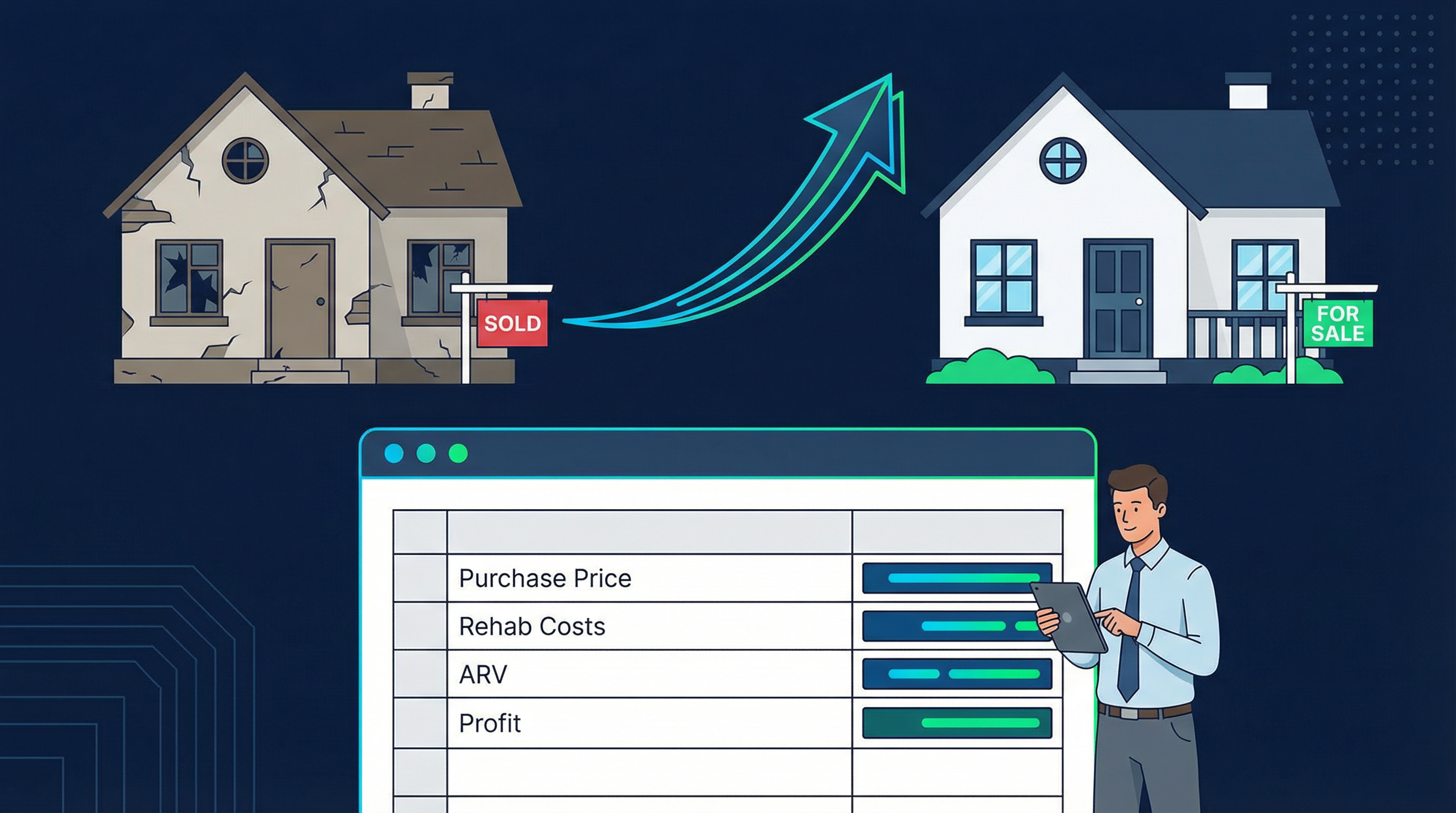

Why Accurate Deal Analysis Makes or Breaks Your First Flip
You found a promising property, but how do you know if the numbers add up? Flipping a house without a systematic process to analyze fix and flip deals is a fast track to losing money. Most beginners overpay or underestimate rehab and holding costs, killing profit margins before they even start.
Your ability to analyze fix and flip deal opportunities with precision determines whether you walk away with a check or a headache. This guide walks you through a step-by-step fix and flip deal analysis guide—from calculating your After Repair Value (ARV) using comps, to setting your Maximum Allowable Offer (MAO).
How Do You Calculate ARV and Why Does It Matter?
Your ARV is the expected resale price after all repairs. It's the foundation of your entire deal analysis. Inaccurate ARV estimates skew every other calculation—repair budgets, holding costs, and ultimately your profit.
Start by pulling comparable sales (comps) for similar properties in the same neighborhood that have sold in the last 3-6 months. Look for homes with similar square footage, bedroom and bathroom count, lot size, and condition after rehab. Adjust for any differences like upgrades or location within the neighborhood.
Using Revamp365’s AI-powered comps tool simplifies this step. It pulls up-to-date, accurate comps automatically, saving you hours and reducing guesswork. The platform’s ARV calculator applies data-driven adjustments so your ARV reflects the true market.
For a deeper dive, check out our guide on how to calculate ARV and how to run comps.
What Is the 70% Rule and How to Use It in Your Offer?
The 70% rule is a quick sanity check to determine your Maximum Allowable Offer (MAO). It says you shouldn’t pay more than 70% of your ARV minus repair costs to leave room for profit and holding expenses.
Here’s the formula:
MAO = (ARV × 70%) − Estimated Repair Costs
Example: ARV = $250,000, Repair Costs = $40,000
MAO = (250,000 × 0.7) − 40,000 = 175,000 − 40,000 = $135,000
You should offer no more than $135,000 on this deal to maintain target margins.
The 70% figure isn’t magic—it’s a conservative baseline that protects you from overpaying. Depending on your market and risk tolerance, you might adjust it between 65% and 75%, but always test with realistic repair estimates.
How to Estimate Repair Costs Accurately
Repair costs are the biggest unknown for new flippers. Underestimate and your profit evaporates. Overestimate and you lose deals.
Start with a detailed scope of work. Walk the property room-by-room and list every repair, from cosmetic fixes to major systems (roof, HVAC, plumbing). Categorize into:
- Cosmetic (paint, flooring, fixtures)
- Structural (foundation, framing)
- Mechanical (electrical, plumbing, HVAC)
Get multiple bids from licensed contractors for each category. Don’t just rely on rough guesses or gut feel.
Add a contingency buffer of 10-15% to cover unexpected issues—flips rarely go 100% according to plan.
Use a fix and flip rehab budget template to organize costs and track bids.

What Are Holding Costs and How Do They Impact Your Profit?
Holding costs pile up the longer your property sits in rehab and on market. They include:
- Loan interest or hard money financing fees
- Property taxes
- Insurance
- Utilities (water, electricity, gas)
- Maintenance and security
If your loan interest is 12% annually on a $150,000 loan, that’s $1,500 per month. A 3-month rehab and sale timeline means $4,500 in interest alone.
Estimate holding costs realistically and add them to your total project expenses before calculating profit margins.
How to Calculate Closing Costs on Buy and Sell Side
Closing costs typically run 2-5% on each side of the deal.
- On purchase: title insurance, escrow fees, transfer taxes, recording fees
- On sale: agent commissions (usually 5-6%), closing fees, transfer taxes
Example: For a $150,000 purchase with 3% closing, budget $4,500. On a $250,000 sale, 6% agent commission alone is $15,000.
Don’t skimp on these numbers—they’re real expenses that can crush your profit if forgotten.
How to Calculate Profit Margin and Fix Flip ROI
Once you have your ARV, repair costs, holding costs, and closing costs, plug them into this formula:
Profit = ARV − (Purchase Price + Repair Costs + Holding Costs + Closing Costs)
ROI = Profit ÷ (Purchase Price + Repair Costs + Holding Costs + Closing Costs) × 100
If your profit is less than your minimum target (often 10-15%), walk away or renegotiate.
Use a house flipping numbers calculator or spreadsheet to automate this math and test multiple scenarios quickly.
What’s Your Maximum Allowable Offer (MAO)?
The MAO is your highest bid that still hits your profit target.
Work backward from your desired profit margin and all costs:
MAO = ARV − (Repair + Holding + Closing Costs + Desired Profit)
If your MAO is below the seller’s asking price, the deal isn’t worth pursuing unless you can negotiate.
Revamp365’s integrated ARV calculator helps you run these numbers in seconds so you can make confident offers faster.
Common Mistakes That Kill Fix and Flip Deals—and How to Avoid Them
1. Overestimating ARV
Relying on outdated or irrelevant comps inflates your ARV. Use current, comparable homes with similar upgrades. Revamp365’s AI comps eliminate this guesswork.
2. Underestimating repairs
Failing to get contractor bids or ignoring a contingency budget leads to surprise costs.
3. Ignoring holding costs
Many newbies forget months of interest and taxes, which can cut profit margins by 20% or more.
4. Skipping closing costs
Not budgeting for agent commissions or transfer taxes is a fatal error.
5. Not using a systematic spreadsheet
Manual calculations lead to errors and slow decision-making. A house flipping numbers calculator streamlines analysis and speeds up offer decisions.
Deal Analysis Checklist: Does This Flip Meet Your Profit Threshold?
- Did you calculate ARV using reliable comps? Try Revamp365 ARV tool
- Have you obtained detailed contractor bids for repairs?
- Is your repair estimate including a 10-15% contingency?
- Have you added realistic holding costs for your estimated timeline?
- Did you factor in closing costs on both buy and sell sides?
- Is the projected profit at least 10-15% ROI after all expenses?
- Does your Maximum Allowable Offer allow room for negotiation?
If you answered yes to all, you’re ready to make an offer. If not, revisit the numbers.
Take Control of Your Fix and Flip Deal Analysis Today
You can’t afford to guess your way through your first deal. Use data-driven ARV comps, detailed repair budgets, and realistic cost assumptions to know exactly where your money is going.
Revamp365’s AI-powered comps and deal analysis tools put this framework at your fingertips — so you can run more deals, make smarter offers, and grow your flipping business faster.
Analyze your first fix and flip deal with Revamp365’s ARV calculator now
The largest database of curated off-market deals in the nation.
Claim Your AccessFor more strategic insights, explore our resources on fix and flip rehab budget and how to run comps.
Start analyzing every deal with confidence. Your first successful flip is just one accurate offer away.