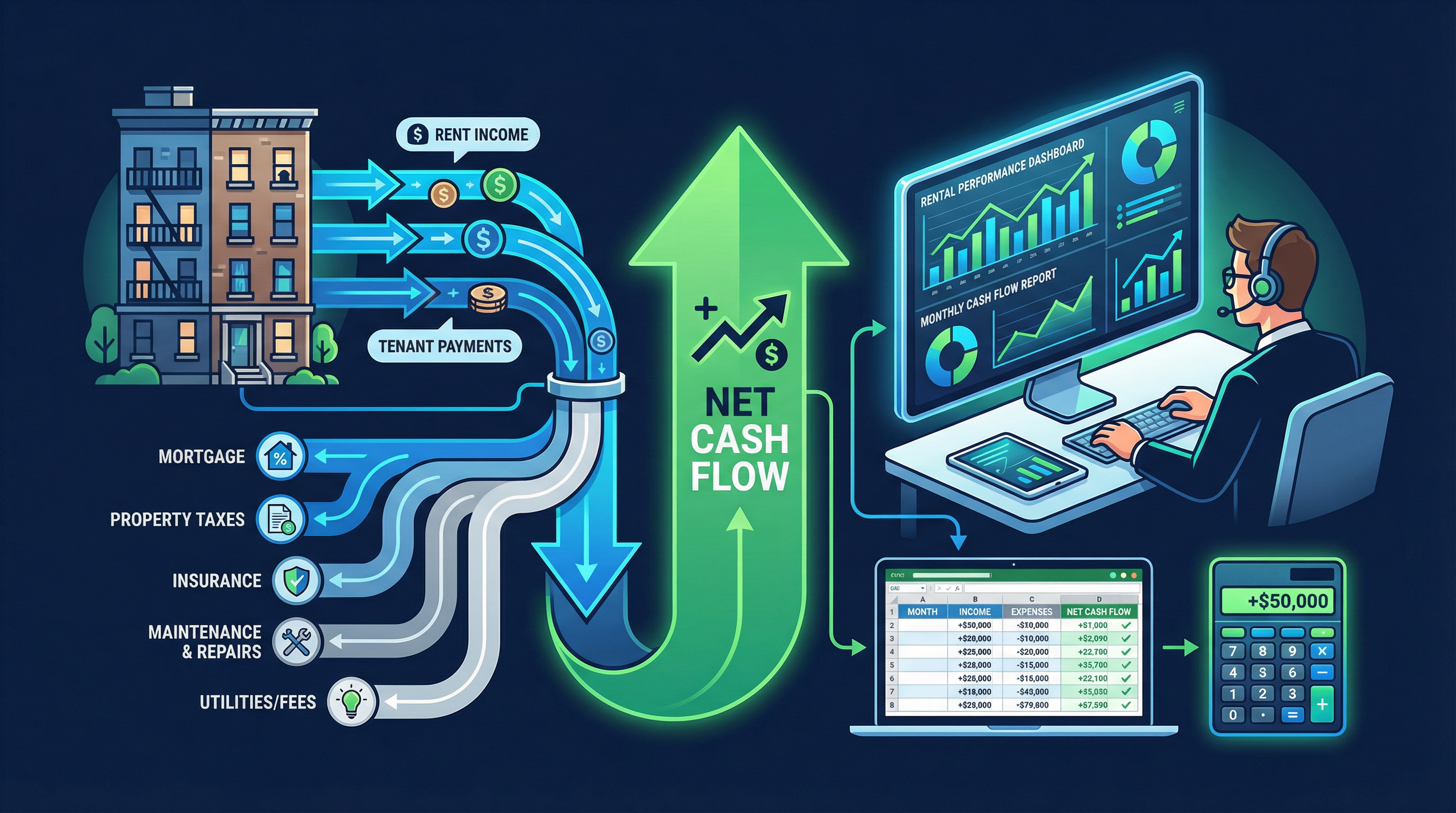

Why You Can't Afford to Skip Cash Flow Analysis
You’ve found a rental property that looks solid on paper, but what if it ends up costing you money every month? Negative cash flow kills deals and drains your capital faster than any rehab nightmare. The harsh truth: without a rigorous cash flow analysis rental property guide, you’re flying blind.
This isn’t about theory. It’s about knowing exactly what each property will throw off in real dollars after every expense, vacancy, and mortgage payment. Investors who master this step consistently pick winners and avoid cash traps.
What Exactly Is Cash Flow Analysis for Rental Properties?
At its core, cash flow analysis means calculating the actual money left in your pocket each month from a rental property after all expenses. This isn’t just rent minus mortgage — you need to factor in realistic vacancy rates, operating expenses, and debt service.
If you skip or underestimate any cost, you risk buying a money pit. The goal: positive cash flow that grows your portfolio sustainably.
How to Calculate Rental Property Cash Flow Step-by-Step
Step 1: Estimate Gross Rental Income
Start by finding accurate rental rates for the property’s market. Don’t guess. Use tools like Revamp365's market data to pull precise rental comps in your target area — down to neighborhood and unit size.
For example, if similar 3-bedroom homes rent for $1,500/month, that’s your gross rental income.
Step 2: Account for Vacancy Rate
Vacancy is inevitable. Use a conservative allowance of 5% to 10%, depending on market conditions. In a stable market, 5% might be realistic; in a volatile one, budget 10% or more.
If gross rent is $1,500/month, a 7% vacancy means subtracting $105 monthly.
Step 3: Calculate Operating Expenses
Operating expenses include:
- Property management fees (typically 8-10% of rent)
- Maintenance and repairs (budget around 5-10% of rent)
- Property taxes (check local tax rates)
- Insurance premiums
- HOA fees, if applicable
For a $1,500 rental, example monthly expenses might be:
- Management: $120 (8%)
- Maintenance: $100 (7%)
- Taxes: $150
- Insurance: $75
- HOA: $50
Total: $495
Step 4: Determine Net Operating Income (NOI)
NOI = Gross Rental Income - Vacancy Loss - Operating Expenses
Using the example:
$1,500 - $105 (vacancy) - $495 (expenses) = $900 NOI
Step 5: Subtract Debt Service (Mortgage Payment)
Calculate your monthly mortgage payment based on loan amount, interest rate, and term. Use an amortization calculator or Revamp365’s integrated tools for precision.
If your monthly mortgage is $700, then:
Cash Flow = NOI - Debt Service = $900 - $700 = $200/month
Step 6: Calculate Cash-on-Cash Return and Cap Rate
Cash-on-Cash Return measures your yearly cash flow relative to your initial cash investment.
If you put $40,000 down, annual cash flow is $2,400 ($200 x 12). Cash-on-cash return = $2,400 / $40,000 = 6%.
Cap Rate is NOI divided by property purchase price.
If purchase price is $150,000, cap rate = $900 x 12 / $150,000 = 7.2%.
Step 7: Use the 1% Rule as a Quick Filter
The 1% rule says monthly rent should be at least 1% of the purchase price to have a chance at positive cash flow.
For $150,000, rent should be $1,500 or more. It’s a shortcut — not a guarantee — but helps weed out poor deals fast.

Where to Find Reliable Rental Rate Data
Guessing rent kills deals. You need data that reflects current market rents for your property type and location.
Start with online listing sites, but cross-verify with local MLS data and property management firms. Better yet, use a platform like Revamp365 that aggregates neighborhood-level rental comps and market trends automatically.
This cuts research time and sharpens your rent estimates so your cash flow forecasts hold up under pressure.
Common Mistakes That Sink Your Cash Flow Analysis
Underestimating Vacancy and Expenses
Vacancy rates below 5% or ignoring maintenance costs are rookie errors. Always pad your numbers conservatively.
Ignoring Property Management Fees
If you plan to outsource management, include the 8-10% fee. Doing it yourself saves money but costs time and energy.
Overpaying Due to Flawed ARV or Market Data
Buying above market value based on hype or inaccurate ARV/AVM models kills returns. Use tools like Revamp365's AI-powered ARV calculator to verify property values before committing.
Skipping Debt Service in Your Calculations
Mortgage payments are often the largest expense. Forgetting them leads to false positives on cash flow.
How Revamp365 Streamlines Your Buy and Hold Real Estate Analysis
Revamp365 combines AI-driven comps, AVM/ARV accuracy, and real-time market data to give you a crystal-clear picture of property value and rental income potential. This means you spend less time digging through spreadsheets and more time closing deals.
Its integrated CRM and SMS marketing also help you scale your pipeline — so you never miss a deal that fits your cash flow criteria.
A Real-World Cash Flow Example for a Single-Family Rental
Purchase Price: $150,000
Down Payment: $40,000
Loan Amount: $110,000
Interest Rate: 5%
Term: 30 years
Monthly Mortgage: $590
Gross Rent: $1,500
Vacancy Rate: 7% ($105/month)
Operating Expenses: $495/month
Net Operating Income: $1,500 - $105 - $495 = $900
Cash Flow: $900 - $590 = $310/month
Annual Cash Flow: $3,720
Cash-on-Cash Return: $3,720 / $40,000 = 9.3%
Cap Rate: $900 x 12 / $150,000 = 7.2%
This deal covers expenses, mortgage, and still generates solid returns.
Deal Evaluation Checklist for Buy-and-Hold Investors
- Verify purchase price using an AI-powered ARV/AVM tool like Revamp365.
- Use accurate local rental comps to project gross income.
- Apply a conservative vacancy rate (5-10%).
- Calculate all operating expenses thoroughly.
- Confirm monthly debt service using your exact loan terms.
- Compute NOI, cash flow, cash-on-cash return, and cap rate.
- Use the 1% rule as a quick sanity check.
- Run your numbers through a rental property ROI calculator to compare deals.
- Reassess if any assumptions seem optimistic.
- Plan for a buffer to cover unexpected costs.
Where to Go Next
Mastering cash flow analysis rental property guide is the difference between scaling and stalling your buy-and-hold portfolio. Use data-driven tools like Revamp365 to remove guesswork from your evaluation process.
If you want to grow your portfolio with confidence, start running every deal through this framework. Your cash flow – and your bank account – will thank you.
Analyze your next rental deal with Revamp365’s AI-powered tools now
The largest database of curated off-market deals in the nation.
Claim Your AccessFor deeper strategy, explore how to maximize returns with the BRRRR strategy or tighten your deal sourcing using how to find off-market deals. To understand local market dynamics better, check out our market analysis resources and refine your pricing with our ARV calculator.