
Hook: When a Zestimate Cost an Investor Thousands
Imagine this: an investor spots a seemingly promising property listed at $250,000 with a Zestimate of $260,000. Confident in this automated valuation, they put in an offer close to the Zestimate, expecting to flip the house for a tidy profit. However, after closing, the investor discovers the property needs $40,000 in renovations, and local comps suggest the post-rehab value (ARV) is closer to $280,000—not enough margin for the risk taken. That $10,000 difference between the purchase price and true value, combined with underestimated rehab costs, quickly erodes profit.
This scenario is common among beginner investors who rely heavily on Zillow’s Zestimate as gospel. The Zestimate, while convenient, often misses the nuance of distressed properties, neighborhood trends, and rehab scope. The result? Overpaying, underestimated expenses, and deals that look profitable on paper but bleed cash in reality.
This is the reality that pits Zillow vs Revamp365 for investors. While Zillow offers a consumer-friendly snapshot of property values, professional investors need much more precision, data depth, and automation to uncover true deal potential and avoid costly missteps.
Context: Zillow Was Built for Consumers, Not Investors
Zillow revolutionized the real estate world by offering free, instant home value estimates to millions of consumers. Its primary goal is to empower everyday buyers and sellers with easy access to property data. The Zestimate algorithm aggregates public records, recent sales, and user inputs to generate an estimated market value. For a homeowner curious about their property’s worth, this is a great starting point.
However, the platform’s design intentionally targets consumer convenience over investment rigor. It lacks tools tailored to investors who analyze properties’ after repair value (ARV), perform detailed comps, or need to reach owners of off-market properties. Zillow doesn’t provide skip tracing, automated outreach, or integrated CRM functions that investors rely on to build pipelines and close deals efficiently. Understanding this distinction is crucial for investors evaluating Zillow vs Revamp365 for investors.
The Zestimate Accuracy Problem for Investment Properties
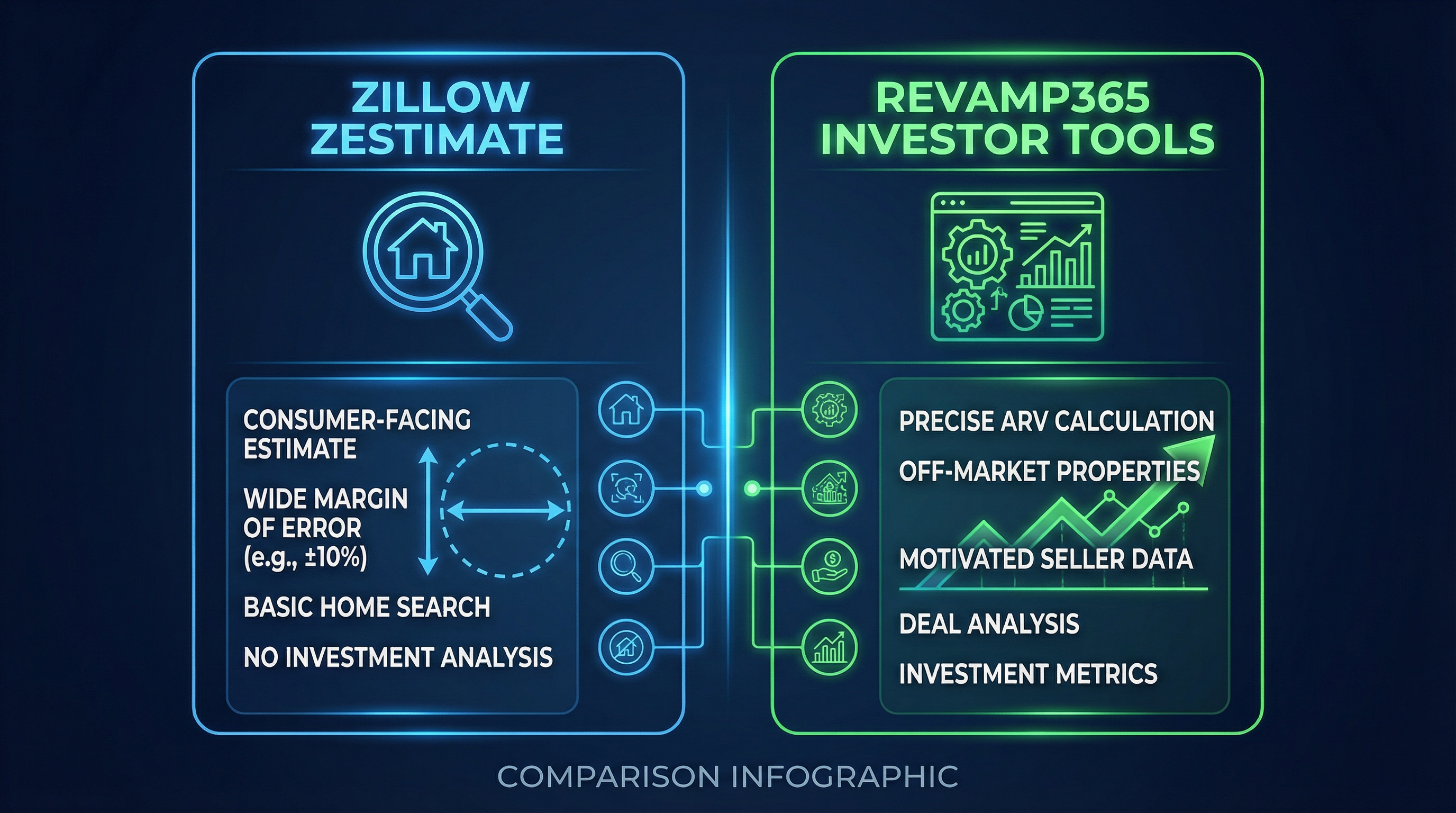
Zestimates are generated by algorithms that analyze historical sales data, tax assessments, and property characteristics. While effective in stable, owner-occupied neighborhoods, these algorithms struggle with distressed and off-market properties—precisely the kinds investors target. Studies and industry analyses reveal that Zestimates can be off by anywhere from 5% to 20% on such properties.
For example, a property in foreclosure or in need of significant repairs often deviates markedly from recent sales data. Zillow’s algorithm may not account for the severity of damage or neighborhood shifts like an increase in investor activity or changing zoning laws. This leads to inflated or deflated values that mislead investors. One investor reported purchasing a vacant property with a Zestimate of $150,000, only to find the actual ARV was closer to $120,000 after factoring in rehab and market conditions.
Moreover, Zestimates refresh only as often as public data updates, causing lag in fast-moving markets. For investors competing in competitive environments, relying solely on these values is a recipe for missed opportunities and overbidding. In contrast, dedicated investment tools use AI and proprietary data to refine valuations dynamically.
ARV vs Zestimate: Why They Are Not the Same Number
A critical concept every investor must grasp is the difference between ARV (After Repair Value) and Zestimate. The Zestimate reflects an estimate of the current market value based on existing conditions, assuming the property is in average shape and market equilibrium. It’s a snapshot, not a projection.
ARV, on the other hand, estimates the property's value after all planned repairs and renovations are complete. It incorporates rehab costs, updated features, and improvements that materially change the property’s desirability and market positioning. ARV is forward-looking and essential for calculating profitability, determining financing, and structuring offers.
Confusing ARV with Zestimate leads many investors to overpay or misjudge rehab budgets. For instance, a property with a Zestimate of $200,000 but requiring $50,000 in renovations might have an ARV of $275,000. The difference reflects the investor’s value-add and the true market value post-renovation. Zillow’s automated tool does not calculate ARV because it cannot assess renovation quality or scope.
Understanding this distinction is why investors seeking the best property valuation tool investors trust turn to platforms that offer customizable, data-rich ARV analysis rather than generic Zestimates.
How to Calculate a Real ARV: A Step-by-Step Walkthrough
Calculating an accurate ARV is fundamental for investment success. Here’s a straightforward method using real numbers to illustrate the process:
Gather Comparable Sales Data: Identify at least three recently sold properties within a half-mile radius that are similar in size, style, and condition—post-renovation. Suppose these comps sold for $280,000, $290,000, and $275,000.
Adjust for Differences: If your property is slightly larger or smaller, or has more bedrooms, adjust the comp prices accordingly. For simplicity, average the comps: ($280,000 + $290,000 + $275,000) / 3 = $281,667.
Estimate Rehab Costs: Conduct a thorough inspection or use contractor bids to estimate renovation expenses. Let’s say rehab costs total $50,000.
Calculate ARV: The ARV is the average comp price, reflecting post-rehab condition. So, ARV = $281,667 (no adjustment needed since we assume similar quality).
Determine Offer Price: Using the 70% rule, an investor might offer 70% of the ARV minus rehab costs: (0.70 * 281,667) - 50,000 = $146,167.
This precise calculation contrasts sharply with relying on a Zestimate, which may not reflect rehab potential or local market nuances. Investors who master ARV calculation gain a strategic edge.
For more detailed guidance on how to run comps, check out our comprehensive guide how to run comps.
What Zillow Cannot Do That Serious Investors Need
While Zillow excels at providing consumer-level data, serious investors require features that Zillow doesn’t offer. First, skip tracing is essential for contacting property owners, especially for off-market deals. Zillow provides owner information only when publicly available but lacks integrated skip tracing capabilities. Platforms like Revamp365 automate this process, enabling investors to reach owners quickly.
Off-market data is another critical gap. Zillow’s listings are mostly publicly marketed properties, while investors thrive on finding hidden gems—vacant homes, pre-foreclosure, expired listings—that never hit MLS. Without access to comprehensive off-market deals, investors limit their pipeline.
Moreover, Zillow lacks integrated CRM systems and outreach automation. Investors need to manage leads, run SMS campaigns, and follow up efficiently. Revamp365’s AI-powered voice agents and CRM tools streamline this workflow, turning data into actionable deals.
These capabilities are why many search for a Zillow alternative for real estate investors, seeking a platform that addresses these real-world needs rather than just providing surface-level valuations.
How Revamp365 Produces Investment-Grade Valuations
Revamp365 leverages advanced AI algorithms combined with rich datasets to generate valuations that reflect true market conditions and rehab potential. Unlike Zestimates, which rely heavily on public records, Revamp365 integrates proprietary off-market data, contractor inputs, and neighborhood trends to produce investment-grade ARVs.
Its AI-powered comps engine synthesizes comparable sales with renovation variables and local market velocity, delivering valuations within a tighter error margin—often within 2-5% of actual sale prices. This precision allows investors to confidently structure offers and forecast profits.
Additionally, Revamp365’s platform unifies valuation with skip tracing, CRM, and automated outreach in one dashboard. This integration reduces time spent toggling between tools and minimizes human error. Investors can run investment-grade comps directly run investment-grade comps and follow up on leads seamlessly.
While not a sales pitch, understanding how Revamp365 produces more reliable valuations clarifies why it’s the preferred choice for professional investors who need accuracy beyond Zillow’s Zestimate.
Mistakes Investors Make When They Trust Zillow Too Much
Investors who rely exclusively on Zillow’s Zestimates often fall into several costly pitfalls:
Overpaying Based on Inaccurate Values: As discussed, Zestimates can be off by up to 20%, especially on distressed properties. This leads to offers that don’t leave room for rehab costs and profit.
Ignoring Rehab Costs and ARV: Many beginners confuse Zestimate with ARV, failing to calculate renovation expenses or the property’s value post-rehab. This oversight skews profitability analyses.
Missing Off-Market Opportunities: Zillow’s focus on listed properties means investors miss out on the lucrative off-market deals that require skip tracing and targeted outreach.
Inefficient Lead Management: Without integrated CRM and communication tools, investors lose track of potential sellers and deals, slowing pipeline velocity.
Relying on Outdated Data: Zillow updates rely on public record refreshes, which can lag weeks or months behind market changes. Investors acting on stale valuations risk falling behind competitors.
Avoiding these mistakes requires embracing specialized tools and processes designed for the unique challenges of real estate investing.
For investors serious about outreach, learning about AI skip tracing can dramatically improve contact rates AI skip tracing.
Closing: Challenge to the Investor
If you’re still relying on Zillow’s Zestimate as your primary valuation tool, it’s time to rethink your strategy. The difference between a good deal and a money-losing mistake often hinges on valuation accuracy and access to comprehensive data. Zillow was designed for homebuyers and sellers, not investors who need precision, speed, and depth.
Forward-thinking investors leverage platforms like Revamp365 to run investment-grade comps, tap into off-market deals, and automate outreach. The market rewards those who act with data-driven confidence and avoid the pitfalls of generic valuations.
Take the next step to elevate your investing game by exploring how to run comps like a pro and uncover off-market deals that Zillow simply can’t surface off-market deals.
Start running smarter comps and find off-market deals today
The largest database of curated off-market deals in the nation.
Claim Your Access